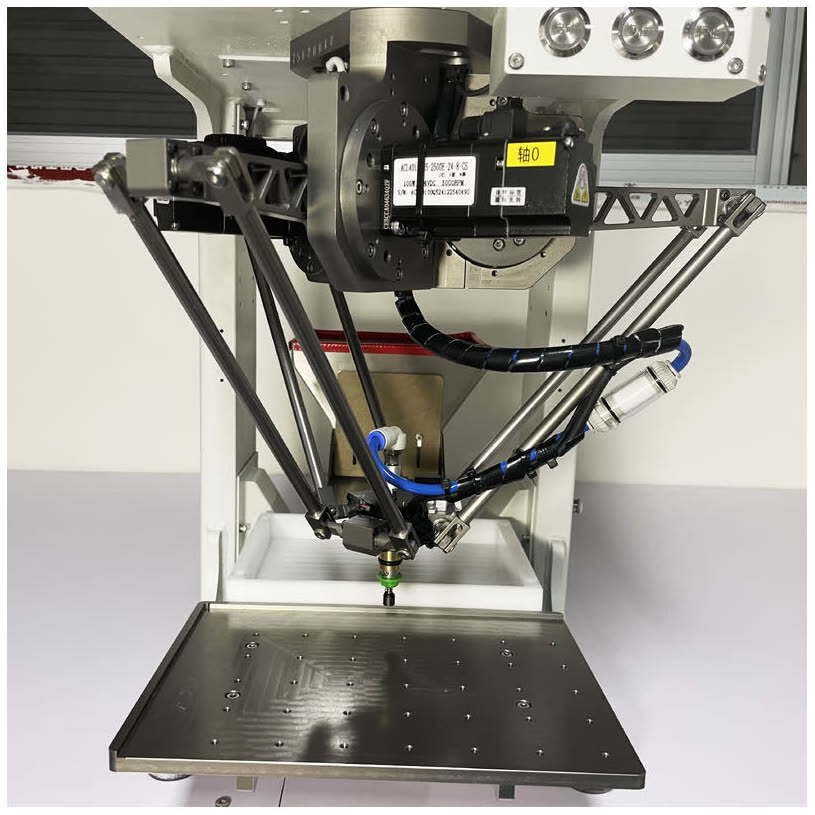
SHENZHEN, GUANGDONG, CHINA, October 29, 2026 /EINPresswire.com/ — Selecting the correct kinematic architecture determines whether an automated packaging or assembly line achieves target cycle times without excessive maintenance downtime. For high-speed transfers of light components under three kilograms, deploying a High Speed Delta Robot delivers superior acceleration and cycle rates compared to traditional articulated or SCARA robot arms. Facilities in 3C electronics, pharmaceutical packaging, and small hardware sorting face continuous throughput demands where fractions of a second govern productivity. Evaluating kinematic structures, payload limits, and footprint constraints helps engineering teams select the right robot for their automation goals.
Kinematic Design and Moving Mass Differences
The primary mechanical distinction between Delta robots and traditional articulated robotic arms lies in actuator placement. Delta robots utilize a parallel kinematic structure where three closed kinematic chains connect a stationary overhead base to a shared end-effector plate. All primary servo motors and gearboxes remain permanently mounted inside the overhead frame. The mechanical arms extending downward consist of hollow carbon fiber rods and lightweight spherical bearings. Because drive motors remain stationary, moving mass consists only of the linkage rods and tooling plate, allowing servo torque to convert directly into rapid workpiece movement.
Traditional articulated six-axis robots operate on a serial kinematic principle where each link connects sequentially to the next joint. Each successive joint carries the physical weight of its own drive motor, gearbox, and internal sensors, along with subsequent joint actuators. Moving joint motors creates a moving mass penalty where motor torque is consumed merely accelerating and decelerating arm mass rather than moving the part. SCARA robots keep their base rotation motor stationary, but intermediate elbow motors still travel across planar sweeps. Parallel linkages eliminate excess inertia, enabling instantaneous directional reversals without mechanical backlash or joint deflection.
Acceleration Rates and Pick-and-Place Throughput
Minimizing moving mass translates directly into higher acceleration profiles. Industrial High Speed Delta Robot units routinely operate at continuous working accelerations reaching 10g to 15g, with specialized models exceeding 20g on short transfer strokes. In high-speed material handling cycles, rapid acceleration and deceleration phases consume the majority of total transfer time. Articulated six-axis arms typically limit acceleration to 1g or 2g to prevent motor overheating and mechanical gearbox fatigue. High-performance industrial SCARA arms rarely exceed 3g to 5g during continuous production shifts.
These acceleration profiles create substantial differences in net hourly throughput across production lines. A standard industrial pick-and-place benchmark involves lifting a product 25 millimeters, translating horizontally across 300 millimeters, lowering 25 millimeters to release, and returning along the same trajectory. Delta robots complete this standard transfer cycle in 0.3 to 0.4 seconds under continuous operating conditions. In real production environments, a single Delta workstation sustains net throughput between 3,000 and 4,500 parts per hour, equating to 50 to 75 parts per minute. Articulated arms handling identical transfer paths typically require 1.0 to 1.5 seconds per complete cycle, yielding sustained throughput between 1,200 and 2,000 parts per hour.
Working Envelope and Footprint Considerations
Workspace geometry represents another vital operational distinction between parallel and serial robot configurations. A modern High Speed Delta Robot generates an inverted dome-shaped working envelope directly beneath its overhead mounting frame. The horizontal operating radius typically ranges from 200 mm to 600 mm, with vertical stroke envelopes extending from 200 mm to 400 mm depending on linkage rod lengths. Because the robot mounts to an overhead gantry or integrated cell frame, the equipment occupies zero factory floor space beneath the primary motion zone.
The overhead layout offers significant engineering advantages for modern automated assembly lines: – Overhead mounting positions the robot directly above moving conveyors and vibrating feeder surfaces, keeping plant walkways unobstructed. – Symmetrical arm linkages provide uniform kinematic velocity and acceleration across the central working area, simplifying vision coordination. – Open space beneath the mounting frame simplifies installation of reject bins, inspection cameras, and vacuum manifolds. – Modular cell designs can cluster multiple Delta units along a narrow conveyor line to multiply sorting capacity without widening machine footprint.
Articulated six-axis robots feature a spherical working envelope that allows them to reach behind their base and access lateral workstations. However, this flexibility requires a dedicated pedestal that consumes valuable floor space and demands extensive perimeter safety fencing.
Payload Capacities and Structural Rigidity Limits
While Delta robots excel in pure kinematic speed, articulated and SCARA robots maintain clear superiority in mechanical payload capacity. An industrial Delta robot is specifically engineered for lightweight manipulation, with standard payload ratings spanning 0.5 kg to 3 kg, and heavy variants supporting up to 5 kg. The parallel linkage rods, constructed from carbon fiber tubes connected by spherical ball joints, are optimized for axial tension and compression. Applying payloads above rated limits introduces micro-vibrations across mechanical links, impairing placement repeatability and accelerating joint wear.
Articulated six-axis robots are designed to support substantial mechanical payloads ranging from 5 kg to well over 500 kg. Their heavy cast aluminum arm segments house high-torque gearboxes capable of sustaining massive torsional loads, making them the standard solution for palletizing cartons and machine tool tending. SCARA robots manage intermediate payloads between 3 kg and 20 kg, making them ideal for press-fit insertion and mechanical dispensing where substantial downward axial force is required. For high-speed applications involving light electronic components, pharmaceutical blisters, and stamped contacts, the payload ceiling of parallel robots aligns naturally with workpiece requirements.
Application Suitability and Selection Criteria
Determining the ideal robot architecture requires balancing throughput targets, component physical properties, workstation dimensions, and process flexibility. Manufacturing engineers should evaluate specific operational conditions when finalizing automation cell specifications: – Select a High Speed Delta Robot when sorting, orienting, or packaging lightweight parts under 3 kg directly from moving continuous conveyors at rates exceeding 50 parts per minute. – Select a Delta robot when integrating intelligent vision guidance with multi-axis flexible vibration feeders, where overhead line-of-sight tracking and rapid repositioning are essential. – Select a SCARA robot for precision vertical insertion, mechanical fastener driving, or dispensing applications where high downward rigidity and moderate cycle rates provide an optimal balance. – Select a six-axis articulated robot when workpieces exceed 3 kg, require complex multi-axis reorientation in three-dimensional space, or must transfer across widely separated physical workstations.
Automation equipment manufacturers such as FIDER engineer compact four-axis Delta workstations that combine overhead parallel mechanics with integrated vision guidance systems. These unified cells achieve repeatability tolerances of ±0.05 mm while sorting up to 4,500 parts per hour, providing a practical automation bridge for high-mix electronic assembly and precision small-part packaging lines.
Equipment Longevity and Operational Maintenance
The mechanical design of industrial robotics directly influences long-term maintenance costs and operational availability. Delta robots feature mechanical simplicity, which translates into lower preventative maintenance requirements throughout their service lifespan. Because all servo motors remain stationary inside the overhead frame, drive power cables and encoder signal lines do not undergo continuous rotational bending, torsional flexing, or dynamic fatigue during high-speed production cycles.
Routine maintenance on parallel robots focuses on accessible mechanical elements: – Periodic visual inspection and cleaning of spherical ball joints and carbon fiber linkage rods to verify smooth articulation without mechanical play. – Checking tension spring retaining cables that hold parallel arm linkages against joint ball studs, ensuring balanced joint preloading. – Lubricating overhead motor gearboxes without entering the product handling zone, preventing lubricant contamination in sensitive packaging environments. – Monitoring end-effector vacuum suction cups and pneumatic rotary actuators that experience continuous cyclic wear.
In contrast, articulated six-axis robots require complex internal cable harnesses routed through hollow joint castings, which experience gradual conductor fatigue that requires extensive harness replacements. Parallel kinematic Delta robots deliver acceleration rates and hourly throughput figures that serial robot arms cannot match for high-speed small-part handling. To evaluate part feeding feasibility or discuss high-speed workstation engineering requirements, review system specifications at https://www.fdrautomation.com/ to schedule a technical consultation.
FIDER
FIDER
Legal Disclaimer:
EIN Presswire provides this news content “as is” without warranty of any kind. We do not accept any responsibility or liability
for the accuracy, content, images, videos, licenses, completeness, legality, or reliability of the information contained in this
article. If you have any complaints or copyright issues related to this article, kindly contact the author above.

Media gallery