The Business Research Company’s Lifting Equipment Market Global Market Report 2026 – Market Size, Trends, And Forecast 2026-2035
LONDON, GREATER LONDON, UNITED KINGDOM, October 12, 2026 /EINPresswire.com/ — The lifting equipment industry is positioned for substantial expansion, driven by ongoing technological advances and increasing infrastructure demands worldwide. As industries modernize and urban development accelerates, the need for efficient, reliable lifting solutions continues to grow. This overview unpacks the market’s size, competitive landscape, key players, and emerging trends shaping its future.
Forecast and Market Size Expectations for Lifting Equipment
The lifting equipment sector is projected to surpass $112 billion by 2030. It forms a significant portion—about 11%—of the broader Other General Purpose Machinery market, which is expected to reach approximately $1,011 billion in the same year. When considering the overall Machinery industry, set to be valued at $5,280 billion by 2030, lifting equipment will account for nearly 2% of the total market value.
Request A Free Sample Of The Lifting Equipment Market Report
https://thebusinessresearchcompany.com/sample_request?id=57815233&type=smp&name=Lifting%20Equipment%20Market%20Report%202026&utm_source=EINPresswire&utm_medium=Paid&utm_campaign=Oct_PR
Competitive Dynamics in the Lifting Equipment Industry
The market is shaped by global industrial manufacturers and specialized material handling firms developing cutting-edge cranes, automated lifting systems, energy-saving models, remote monitoring solutions, and digital controls. These companies prioritize safety, precision in load handling, durability under tough conditions, minimal downtime, and adherence to regulations. Understanding this competitive environment offers insights into innovation, partnerships, and growth opportunities within industrial automation and material handling sectors.
Leading Company in the Lifting Equipment Market
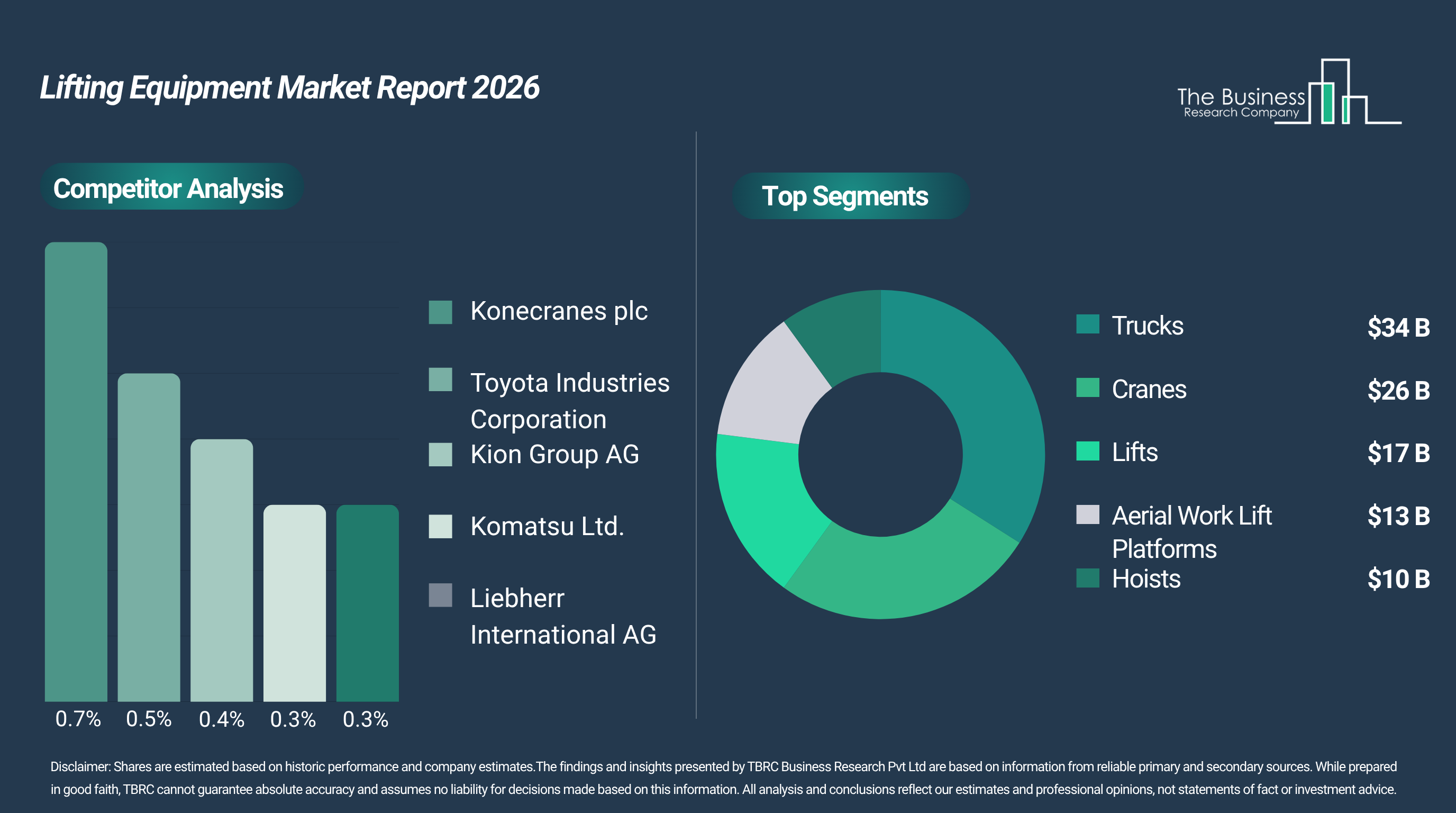
According to The Business Research Company, Konecranes plc held the top spot in global sales by 2025 with a 1% market share. Their lifting equipment and service division provides a comprehensive array of industrial cranes, hoists, port handling machinery, and lifting technologies that enhance material flow, operational efficiency, equipment longevity, and workplace safety across manufacturing and industrial settings.
Access The Detailed Lifting Equipment Market Report Here
https://thebusinessresearchcompany.com/report/lifting-equipment-global-market-report?utm_source=EINPresswire&utm_medium=Paid&utm_campaign=Oct_PR
Asia-Pacific Emerges as the Largest Regional Market
By 2030, the Asia-Pacific region is anticipated to lead the lifting equipment market at $49 billion, growing from $35 billion in 2025 with a compound annual growth rate (CAGR) of 7%. This rapid growth is fueled by booming construction and infrastructure projects in emerging economies, expanding industrial automation, heightened need for effective material handling solutions in factories, significant investments in logistics and warehousing improvements, as well as advanced lifting equipment needs in energy and utility sectors.
Dominant Segment Within the Lifting Equipment Market
The lifting equipment market includes various product types such as trucks, lifts, cranes, hoists, jacks, aerial work platforms, and others. Among these, trucks are expected to be the leading segment in 2030, accounting for 30% or $34 billion of the total market. Growth in this segment is driven by demand for material movement across industries, warehouse lift trucks, expanding e-commerce and distribution networks, high-capacity factory handling requirements, and innovations in electric and automated trucks that boost productivity and efficiency.
Additional Market Segmentation Details
The market categorizes lifting equipment by mechanism into mechanical, hydraulic, pneumatic, electric, and magnetic types. Applications are segmented into construction, government, power, industrial, and telecommunication sectors, reflecting diverse usage across industries.
Primary Growth Factors Fueling Market Expansion
Three critical drivers are expected to accelerate the lifting equipment market up to 2030. These include: rapid infrastructure growth, industrial expansion, and urban construction; the rise of smart city projects and large-scale transportation infrastructure developments; and increasing demand for heavy lifting capabilities in construction projects.
Infrastructure Growth and Urban Expansion Supporting Demand
The construction of commercial buildings, residential complexes, industrial facilities, and public infrastructure necessitates efficient lifting systems that ensure faster material handling, improved productivity, and safer worksites. Expansion of industrial activities further encourages the deployment of cranes, hoists, and lifting platforms, contributing about 1.5% annual growth to the market.
Smart Cities and Large Infrastructure Projects Driving Growth
Development of airports, metro systems, highways, railways, and urban renewal projects requires dependable lifting machinery capable of precise placement of large components, speeding up construction timelines and enabling complex builds. Government investments in modernization and the large scale of these projects are predicted to add around 1.4% growth annually.
Rising Heavy Lifting Needs in Complex Construction
With increasingly sophisticated construction projects, there is a stronger demand for lifting equipment that can safely and accurately move heavy materials, prefabricated elements, and large machinery. This trend supports wider adoption of cranes, hoists, and aerial platforms, contributing approximately 1.0% annual growth through 2030.
Market Share Distribution Among Leading Companies
The lifting equipment market is fairly fragmented, with the top 10 firms collectively holding only 3% of total revenue as of 2025. Barriers to entry vary due to the complexity of engineering, technological advancements, customization demands, and broad service and distribution needs. Market leaders maintain their positions by offering extensive product portfolios, serving a global industrial customer base, and advancing automation, load handling, and equipment durability. As demand increases for intelligent, efficient lifting solutions, companies focus on innovation, strategic partnerships, and expanding regional services.
Top Players and Their Market Shares in 2025
1. Konecranes plc – 1%
2. Toyota Industries Corporation – 0.5%
3. Kion Group AG – 0.4%
4. Komatsu Ltd. – 0.3%
5. Liebherr International AG – 0.3%
6. Tadano Ltd. – 0.3%
7. Terex Corporation – 0.2%
8. Palfinger AG – 0.2%
9. Logisnext Co. Ltd. – 0.1%
10. Jungheinrich AG – 0.1%
Key Trend Revolutionizing the Lifting Equipment Market
Modular lift truck platforms are reshaping the industry by offering greater operational flexibility, boosting efficiency, and enabling digitally connected lifting operations across industrial and port environments. For example, in May 2026, Konecranes plc introduced its Generation D lift truck platform, featuring diesel and electric reach stackers built on modular architecture with advanced digital management, remote diagnostics, over-the-air updates, and secure cyber-infrastructure. These innovations enhance fleet performance, reduce downtime, and support sustainable lifting practices.
Strategies That Keep Market Players Competitive
Leading companies focus on integrating smart connected lifting technologies that enhance automation, promoting electrification for eco-friendly operations, implementing remote monitoring for safety and performance improvements, utilizing advanced materials to increase load capacity and durability, and making strategic investments to broaden intelligent material handling capabilities.
Opportunities for Growth Across Lifting Equipment Types
Various lifting equipment types—including trucks, lifts, cranes, hoists, jacks, and aerial work platforms—represent the most promising growth opportunities. Collectively, they are forecasted to contribute over $24 billion to the market’s value by 2030. Specifically, trucks are expected to grow by $7 billion, lifts by $4 billion, cranes by $6 billion, hoists by $2 billion, jacks by $1 billion, aerial work platforms by $3 billion, and other types by $1 billion between 2025 and 2030. This growth is driven by rising demand for efficient material handling, sophisticated lifting technology in construction and industry, enhanced safety standards, high-capacity equipment, and automation with energy-efficient systems—reflecting greater emphasis on productivity, workplace safety, and infrastructure development.
Common Questions About the Lifting Equipment Market
Q: What is the expected growth rate of the lifting equipment market?
A: The lifting equipment market is anticipated to grow at a compound annual growth rate of 5% through 2030.
Q: Which country is expected to be the largest lifting equipment market?
A: China is projected to lead in 2030 with a market value of $26 billion, increasing from $19 billion in 2025 at a 7% CAGR. This growth is supported by extensive infrastructure projects, a strong domestic manufacturing base, increasing use of cranes and lifting systems at construction sites, investments in smart factory initiatives, and technological advancements improving efficiency, safety, and reliability.
Q: Who are the major companies in the lifting equipment sector?
A: Key players include Konecranes plc, Toyota Industries Corporation, Kion Group AG, Komatsu Ltd., Liebherr International AG, Tadano Ltd., Terex Corporation, Palfinger AG, Logisnext Co. Ltd., Jungheinrich AG, XCMG Group, Mammoet Holding BV, Daifuku Co. Ltd., Zoomlion Heavy Industry Science and Technology Co. Ltd., Hyster-Yale Materials Handling Inc., Hiab Corporation, Columbus McKinnon Corporation, Anhui Heli Co. Ltd., Haulotte Group, and Ingersoll Rand Inc.
Q: Which companies supply the raw materials for lifting equipment?
A: Prominent raw material suppliers include ArcelorMittal, Nippon Steel Corporation, POSCO Holdings Inc., Tata Steel Limited, SSAB AB, Nucor Corporation, Thyssenkrupp AG, United States Steel Corporation, Baosteel Group Corporation, JFE Steel Corporation, Rio Tinto Group, BHP Group Limited, Alcoa Corporation, Norsk Hydro ASA, Constellium SE, Novelis Inc., Timken Company, SKF Group, Schaeffler AG, and NSK Ltd.
Q: Who are the key wholesalers and distributors in this market?
A: Major wholesalers and distributors comprise Grainger Inc., Fastenal Company, Applied Industrial Technologies Inc., Motion Industries Inc., MSC Industrial Direct Co. Inc., Wajax Corporation, TVH Group, Lifting Gear UK Limited, Bishop Lifting Products Inc., Certex Lifting Ltd., All-Lift Systems LLC, Hoist UK Limited, Crane Depot, Industrial Rigging & Supply, Mazzella Companies, LGH Group, Delta Rigging & Tools, SafetyLiftinGear, and Rope and Sling Specialists Ltd.
Q: What are the primary end users of lifting equipment?
A: Leading end users include Caterpillar Inc., Bechtel Corporation, Fluor Corporation, Vinci SA, Skanska AB, Bouygues Construction SA, Larsen & Toubro Limited, Hyundai Engineering & Construction Co. Ltd., China State Construction Engineering Corporation, Samsung Heavy Industries Co. Ltd., Hyundai Heavy Industries Co. Ltd., Boeing Company, Airbus SE, Volkswagen AG, General Motors Company, Tesla Inc., Amazon.com Inc., DHL Group, Maersk Group, and FedEx Corporation.
Expanded capabilities in our 2026 market reports:
• Market attractiveness scoring and analysis
• Total addressable market (TAM) analysis
• Company scoring matrix graphics and tables
• Excel-based forecasting dashboards
• Market hotspots infographics
• Key technologies and future trend analysis
• Updated graphics and tables
Learn More About The Business Research Company
The Business Research Company (www.thebusinessresearchcompany.com) is a leading market intelligence firm renowned for its expertise in company, market, and consumer research. We have published over 30,000+ reports across 27 industries and 60+ geographies. Our research is powered by 1,500,000 datasets, extensive secondary research, and exclusive insights from interviews with industry leaders.
We provide continuous and custom research services, offering a range of specialized packages tailored to your needs, including Market Entry Research Package, Competitor Tracking Package, Supplier & Distributor Package and much more.
Disclaimer: Please note that the findings, conclusions and recommendations that TBRC Business Research Pvt Ltd delivers are based on information gathered in good faith from both primary and secondary sources, whose accuracy we are not always in a position to guarantee. As such TBRC Business Research Pvt Ltd can accept no liability whatever for actions taken based on any information that may subsequently prove to be incorrect. Analysis and findings included in TBRC reports and presentations are our estimates, opinions and are not intended as statements of fact or investment guidance.
Contact Us:
The Business Research Company
Americas +1 310-496-7795
Europe +44 7882 955267
Asia & Others +44 7882 955267 & +91 8897263534
Email: marketing@tbrc.info
Follow Us On:
LinkedIn: https://in.linkedin.com/company/the-business-research-company“
Oliver Guirdham
The Business Research Company
+44 7882 955267
info@tbrc.info
Visit us on social media:
LinkedIn
Facebook
X
Legal Disclaimer:
EIN Presswire provides this news content “as is” without warranty of any kind. We do not accept any responsibility or liability
for the accuracy, content, images, videos, licenses, completeness, legality, or reliability of the information contained in this
article. If you have any complaints or copyright issues related to this article, kindly contact the author above.

Media gallery