NEW YORK, NY, UNITED STATES, September 23, 2026 /EINPresswire.com/ — The global aluminum extrusion market is expanding as industries increasingly seek lightweight, durable, recyclable, and energy-efficient materials. Aluminum extrusions are widely used in construction, automotive and transportation, electrical and electronics, consumer products, and machinery, making the material an important component of modern industrial and infrastructure development.
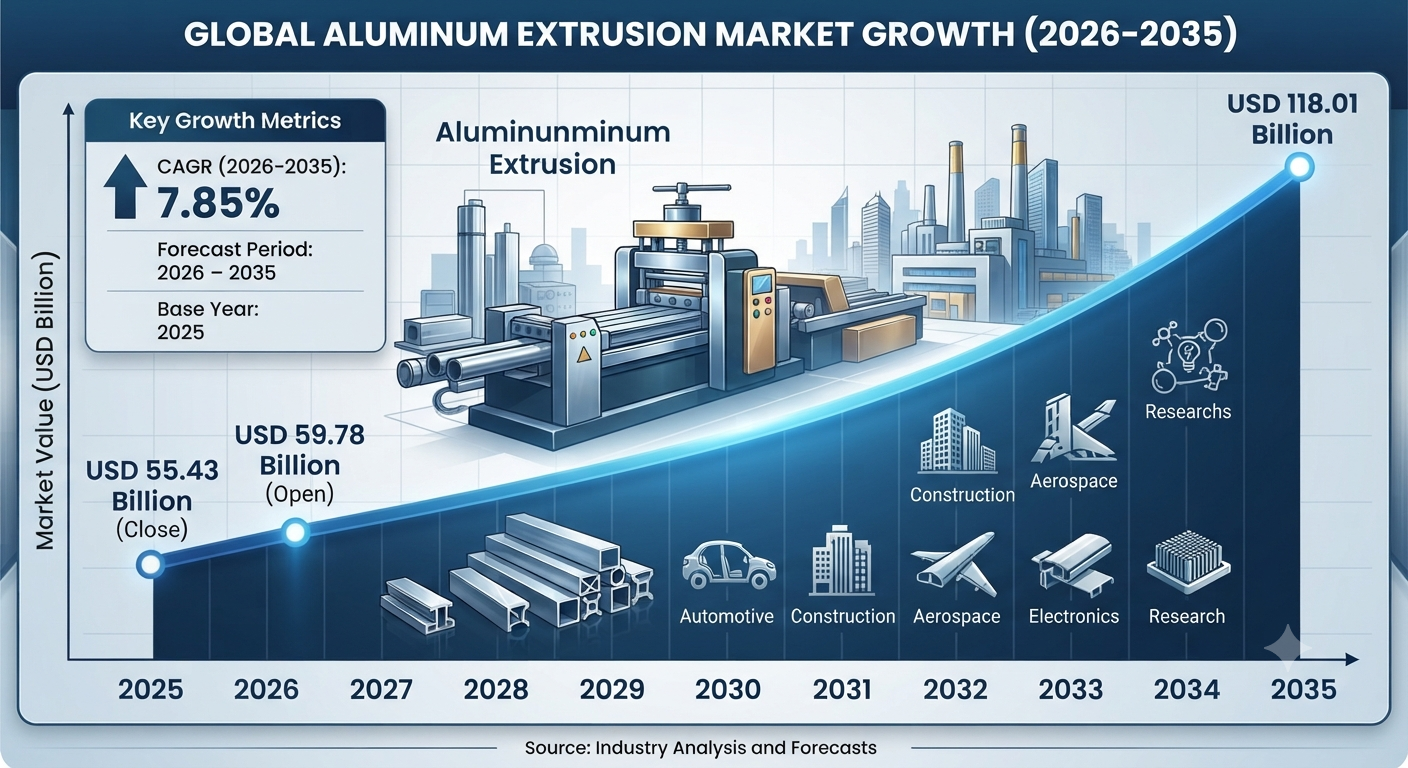
According to the latest Market Research Future analysis, the global aluminum extrusion market was valued at approximately USD 55.43 billion in 2025 and is estimated to reach USD 59.78 billion in 2026. The market is projected to grow to approximately USD 118.01 billion by 2035, registering a compound annual growth rate (CAGR) of 7.85% between 2026 – 2035.
The market’s development is being influenced by growing infrastructure investment, increasing demand for lightweight automotive components, technological improvements in extrusion processes, and the industry’s growing focus on recycling and sustainability.
What Is the Aluminum Extrusion Market?
Aluminum extrusion is a manufacturing process in which aluminum alloy is forced through a shaped die to create profiles with specific cross-sectional designs. The process enables manufacturers to produce complex shapes while maintaining the lightweight and corrosion-resistant characteristics of aluminum.
Extruded aluminum products can be manufactured in different finishes, including mill finished, anodized, and powder coating. Different alloy series are also selected according to the required strength, corrosion resistance, formability, and application.
Because aluminum can be recycled repeatedly, extrusion is also increasingly connected with circular-economy strategies and efforts to reduce the environmental impact of manufacturing.
Get Sample @ https://www.marketresearchfuture.com/sample_request/10688
Key Factors Driving Market Growth
Rising Demand for Lightweight Materials
Weight reduction has become an important consideration across multiple industries.
In automotive manufacturing, lighter components can contribute to vehicle efficiency and performance. The growth of electric vehicles is also creating demand for lightweight materials because reducing vehicle weight can help manufacturers optimize energy consumption and battery performance.
Aluminum extrusions can provide structural strength while reducing weight, making them useful for vehicle frames, structural components, heat-management systems, and other applications.
Market Research Future identifies the growing automotive demand for lightweight materials as an important market driver.
Infrastructure and Construction Development
Building and construction remains the largest application area for aluminum extrusion.
Extruded aluminum is used in window and door frames, curtain walls, roofing systems, structural components, and other architectural applications. Its corrosion resistance, relatively low weight, durability, and design flexibility make it suitable for both commercial and residential projects.
Continued urbanization and infrastructure development, particularly in emerging economies, are therefore expected to support market growth.
Sustainability and Recycling
Sustainability is becoming increasingly important throughout the aluminum value chain.
Aluminum can be recycled and reused, supporting efforts to reduce material waste and improve resource efficiency. Manufacturers are increasingly incorporating recycled aluminum into their production strategies while investing in processes intended to reduce energy consumption and emissions.
The increasing focus on circular-economy principles is consequently creating additional demand for sustainable aluminum products.
Technological Advancements
Advances in extrusion technology are improving production efficiency, dimensional accuracy, and product quality.
Modern die designs, automated production systems, digital monitoring, and Industry 4.0 technologies can help manufacturers produce increasingly complex aluminum profiles while improving process control.
These developments are also expanding the range of applications for extruded aluminum.
Market Segmentation
The aluminum extrusion market can be segmented by product type, alloy type, application, and region.
By Product Type
The major product categories are:
Mill finished
Anodized
Powder coated
Mill finished aluminum currently represents the dominant product category because of its versatility and cost-effectiveness.
Anodized aluminum is experiencing strong demand because the treatment improves surface durability and corrosion resistance while offering an attractive appearance. It is particularly relevant to architectural applications.
Powder-coated aluminum is also used where manufacturers require specific colors, surface protection, and durability.
By Alloy Type
The market includes:
2000 Series Aluminum
3000 Series Aluminum
5000 Series Aluminum
6000 Series Aluminum
7000 Series Aluminum
The 6000 Series represents the largest alloy category in the report. These alloys offer a combination of strength, workability, and corrosion resistance, making them suitable for construction, structural applications, and automotive components.
The 5000 Series is identified as an emerging category, with applications benefiting from its corrosion resistance and weldability.
By Application
Major application areas include:
Building and construction
Automotive and transportation
Electrical and electronics
Consumer goods
Machinery
Building and construction currently represents the largest application segment. Automotive and transportation is emerging as a rapidly expanding area as manufacturers increasingly use lightweight materials.
The expansion of electric vehicles could further support demand for specialized aluminum profiles and structural components.
Buy Now @ https://www.marketresearchfuture.com/checkout?currency=one_user-USD&report_id=10688
Regional Market Outlook
North America
North America is currently identified as the largest regional market, supported by established automotive and construction industries.
The region accounted for approximately 35% of the global market, according to the MRFR report. Demand is being supported by lightweight vehicle applications, construction activity, recycling initiatives, and investments in advanced manufacturing technologies.
The United States and Canada are important markets, with major industry participants including Alcoa and Novelis.
Europe
Europe represents another significant market, with approximately 30% of global market share according to the report.
The region’s aluminum extrusion industry is strongly influenced by sustainability objectives, environmental regulations, automotive manufacturing, and investments in recycling and energy-efficient technologies.
Germany, France, and Italy are among the important markets in the region.
Asia-Pacific
Asia-Pacific is identified as the fastest-growing regional market, supported by industrialization, urbanization, infrastructure development, and increasing manufacturing activity.
China is the largest contributor within the region, while Japan and India are also significant markets. Demand is growing across construction, automotive, electronics, and industrial applications.
India is also developing a substantial domestic aluminum extrusion industry. Market Research Future separately estimates India’s aluminum extrusion market at USD 8.17 billion in 2024, with a projected increase to USD 19.45 billion by 2035.
Middle East and Africa
The Middle East and Africa market is being supported by infrastructure investment, industrial development, and efforts to expand manufacturing capabilities.
The region represents approximately 10% of global market share according to the report. The UAE and South Africa are among the markets contributing to regional development.
Major Market Trends
Growth of Electric Vehicles
The transition toward electric mobility is creating new applications for aluminum extrusion.
Electric vehicles require lightweight structures and thermal-management solutions, while manufacturers are also exploring aluminum components to optimize vehicle weight and efficiency.
This trend is expected to support demand for specialized aluminum profiles in battery systems, vehicle structures, and other components.
Increased Use of Recycled Aluminum
Recycled aluminum is becoming an increasingly important part of sustainability strategies.
Using recycled material can support resource conservation and reduce the environmental footprint associated with primary aluminum production. The growing emphasis on low-carbon manufacturing is therefore encouraging companies to develop more circular aluminum supply chains.
Automation and Smart Manufacturing
Automation is transforming aluminum extrusion facilities.
Sensors, real-time process monitoring, artificial intelligence, predictive maintenance, and automated handling systems can help manufacturers improve production consistency and reduce waste.
Digital technologies can also help manufacturers respond to increasing demand for customized aluminum profiles.
Demand for Customized Profiles
Architectural and industrial customers increasingly require profiles designed for specific applications.
Advanced extrusion equipment and improved die technology allow manufacturers to create complex geometries and customized shapes. This provides opportunities for companies that can offer specialized products rather than relying solely on standardized profiles.
Opportunities in the Aluminum Extrusion Market
Infrastructure Development
Continued investment in buildings, transportation infrastructure, renewable-energy facilities, and urban development is creating opportunities for aluminum extrusion manufacturers.
Demand can increase for structural profiles, window and door systems, façade components, and other architectural products.
Automotive and Transportation
The automotive industry provides opportunities for higher-value aluminum extrusion products.
As manufacturers seek to reduce vehicle weight and improve efficiency, extruded aluminum can be incorporated into structural and thermal-management applications.
Electric vehicle production may further expand this opportunity.
Renewable Energy
Solar and other renewable-energy projects require lightweight and durable structural components.
Aluminum extrusion can be used in solar-panel frames, mounting systems, and related infrastructure. The expansion of renewable-energy installations therefore provides another potential source of demand.
Advanced Recycling Technologies
Investment in aluminum recycling technologies can create opportunities for manufacturers seeking to reduce raw-material costs and improve sustainability.
Better scrap sorting, processing, and remelting technologies can strengthen the integration of recycled aluminum into extrusion production.
Read More @ https://www.marketresearchfuture.com/reports/aluminum-extrusion-market-10688
Challenges Facing the Market
Despite its positive growth outlook, the aluminum extrusion industry faces several challenges.
Fluctuating Aluminum Prices
Raw-material prices can have a significant effect on extrusion manufacturers.
Because aluminum is the primary input, changes in commodity prices can influence production costs, margins, and final product prices. Market participants therefore need effective procurement and cost-management strategies.
High Energy Requirements
Aluminum production and processing can be energy-intensive. Energy prices and the availability of low-carbon electricity can therefore influence manufacturing economics.
This is encouraging manufacturers to explore energy-efficient processes and renewable-energy sources.
Competitive Pressure
The global aluminum extrusion industry includes numerous regional and international manufacturers.
Competition based on price, quality, delivery time, product customization, and manufacturing capabilities can place pressure on margins. Companies are consequently investing in automation and differentiated products to strengthen their market positions.
Trade and Regulatory Issues
International trade policies, tariffs, anti-dumping investigations, and changing environmental regulations can influence aluminum supply chains.
For example, the MRFR report notes an anti-dumping investigation initiated in Thailand concerning extruded aluminum imports from China. Such trade measures can affect regional pricing and sourcing strategies.
Future Outlook
The outlook for the aluminum extrusion market is closely connected with the global transition toward lightweight, efficient, and recyclable materials.
Construction is expected to remain an important source of demand, while automotive and transportation applications are likely to become increasingly significant. Electric vehicles, renewable-energy infrastructure, smart buildings, and advanced industrial equipment can all create new applications for extruded aluminum.
Technological developments will also remain important. Automation, advanced die design, digital process monitoring, and improved recycling technologies can help manufacturers increase productivity while responding to sustainability requirements.
Browse More Reports:
Silicon Nitride Market https://www.marketresearchfuture.com/reports/silicon-nitride-market-8132
Hydrazine Hydrate Market https://www.marketresearchfuture.com/reports/hydrazine-hydrate-market-6585
Glyoxylic Acid Market https://www.marketresearchfuture.com/reports/glyoxylic-acid-market-3158
polyethylene furanoate film market https://www.marketresearchfuture.com/reports/polyethylene-furanoate-film-market-32500
prepreg pre impregnated composite fiber market https://www.marketresearchfuture.com/reports/prepreg-pre-impregnated-composite-fiber-market-25220
redox enzymes market https://www.marketresearchfuture.com/reports/redox-enzymes-market-39600
silicone textile chemical market https://www.marketresearchfuture.com/reports/silicone-textile-chemical-market-38095
Market Research Future
Market Research Future
+1 855-661-4441
email us here
Legal Disclaimer:
EIN Presswire provides this news content “as is” without warranty of any kind. We do not accept any responsibility or liability
for the accuracy, content, images, videos, licenses, completeness, legality, or reliability of the information contained in this
article. If you have any complaints or copyright issues related to this article, kindly contact the author above.

Media gallery