
/C O R R E C T I O N — Acceleration Agency/
PR Newswire
LOS ANGELES, July 14, 2026
In the news release, The New Front Door to Fandom: How Gen Z Is Redefining What It Means to Be a Sports Fan, issued 14-Jul-2026 by Acceleration Agency over PR Newswire, we are advised by the company that changes have been made. The complete, corrected release follows, with additional details at the end:
The New Front Door to Fandom: How Gen Z Is Redefining What It Means to Be a Sports Fan
New research from ACC finds Gen Z is discovering sports via athletes, creators, entertainment and culture long before becoming fans of the sport itself.
LOS ANGELES, July 14, 2026 /PRNewswire/ — Nearly half (49%) of Gen Z sports fans say they have become interested in a new sport or athlete because of fan-created content or something entirely outside the sport, from a Netflix documentary or TikTok fan edit to an athlete’s personal relationship. Meanwhile, 32% say they support individual athletes over specific teams, and 25% of Gen Z overall would rather follow an athlete’s personal story than watch them compete.
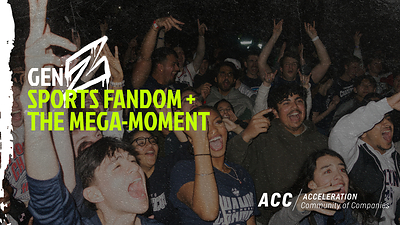
The findings come from a new report, Gen Z Sports Fandom & The Mega-Moment, released today by Acceleration Community of Companies (ACC). The research explores how Gen Z discovers, engages with and sustains sports fandom as Los Angeles hosts an unprecedented run of global sporting events, including FIFA World Cup matches this summer, Super Bowl LXI in 2027, and the 2028 Summer Olympics.
For decades, sports fandom followed a familiar pattern: team loyalty was inherited, viewership was habitual, and fandom often began with geography or family tradition. Today’s younger audiences are taking a different path. Increasingly, they discover sports through creators, entertainment, social media, fashion, gaming, athlete personalities, and internet culture before they become fans of the sport itself.
This report represents an ongoing collaborative research program between industry experts at ACC and public relations students at the USC Annenberg School for Communication and Journalism. Dubbed the USC Annenberg X ACC Think Tank, the directed research course is designed for public relations students to explore emerging cultural and consumer trends through collaborative research, discussion, and analysis.
To understand how Gen Z is reshaping sports fandom, researchers combined national survey data, community research and live focus groups. The study included a nationally representative survey of 2,154 Gen Z adults conducted in partnership with YouGov and secondary data from YouGov Profiles, alongside a global community survey, and in-depth discussions with USC students ranging from die-hard fans to casual participants and sports skeptics.
“For previous generations, the game was the front door to fandom. For Gen Z, it’s often the last stop,” said Monica Chun, President of ACC. “Young fans aren’t necessarily falling in love with the sport first. They’re falling in love with the athlete, the story, the creator, the controversy, or the community around it. A celebrity relationship or a Tik Tok video can be just as powerful as the game itself. Sports used to create culture. Increasingly, culture is creating sports fans.”
“The real story isn’t that Gen Z consumes sports differently. It’s that they’re redefining what counts as sports fandom in the first place,” said Matthew Le Veque, Professor at the USC Annenberg School for Communication and Journalism. “Following an athlete, sharing highlights, watching a documentary, participating in online communities, or showing up for a major cultural moment are all valid expressions of fandom. The organizations that recognize that shift will be best positioned to build the next generation of fans.”
HIGHLIGHTS OF THE STUDY INCLUDE:
Sports fandom increasingly starts outside the sport itself:
- 49% of Gen Z sports fans have become interested in a new sport or athlete because of fan-created content or something beyond the competition itself.
- 25% of Gen Z would rather follow an athlete’s personal story than watch them compete.
The athlete era is here:
- Only 26% of Gen Z identify as “die-hard” fans who regularly watch full games.
- Nearly half (48%) fall somewhere between casual and die-hard fandom, engaging primarily through athletes, highlights, social content and major moments.
The experience around the game matters as much as the game:
- 78% of Gen Z sports viewers have attended or would attend a major sporting event primarily for surrounding experiences such as concerts, fan festivals, celebrity appearances or brand activations.
- Just 8% of Gen Z who watch or follow sports say they stay off their phones entirely while watching sports.
The road to LA28:
- Nearly two-thirds (65%) of Gen Z say they would watch a Drive to Survive-style documentary series following athletes through the Olympic Games.
- 31% of both sports fans and non-fans would choose a mega-event such as the Olympics or FIFA World Cup over other sports experiences tested if given the opportunity. Among sports fans, that figure rises to 38%.
Why This Matters
The findings challenge the narrative that Gen Z is disengaging from sports. Instead, they suggest fandom is expanding.
And as Los Angeles prepares to host the FIFA World Cup, Super Bowl LXI and the 2028 Olympic and Paralympic Games, the organizations best positioned to win Gen Z’s attention will be those that recognize the game is no longer the only gateway into fandom.
Check out the full report at www.accelerationcc.com/intelligence
All figures, unless otherwise stated, are from YouGov Plc. Total sample size was 2,154 adults who are part of Generation Z (born 1997 or later). Fieldwork was undertaken between May 12-20, 2026. The survey was carried out online. The figures have been weighted and are representative of all U.S. adults aged 18-29. The report also incorporates secondary research from YouGov Profiles, drawing on rolling survey data collected by YouGov Plc. between June 2025 and June 2026. Findings are based on a 52-week dataset that is updated weekly. Data is nationally representative in the US and weighted.
About ACC
Acceleration Community of Companies (ACC) is a network of culture driving media, marketing, and communications agencies that include Advisory, ACC’s in-house marketing consultancy; MKG; a leading creative and experiential agency; Pink Sparrow, an award-winning design and fabrication shop; renowned communications and marketing firm DKC, creative and content shop Hangar Four; Stripe Theory, a data and marketing analytics firm; Pixly, a full-service influencer marketing agency; Trailblaze, a lifestyle communications firm; Ingenuity Group, a talent consultancy; and PMK Entertainment, an entertainment public relations agency. ACC’s clients include a range of Fortune 500 brands, from Pepsi, Target, Airbnb, BMW, Meta, Google, Delta Airlines, Dolby, T-Mobile, HBO, Nike, and Netflix, among others.
The Annenberg School for Communication and Journalism at the University of Southern California is an international leader in education and scholarship in the fields of communication, journalism, public diplomacy and public relations. With an enrollment of more than 2,200 students, USC Annenberg offers graduate and undergraduate degree programs that prepare the most promising minds to inquire, innovate and lead at the global crossroads of media, technology, and culture.
Correction: The first hyperlink in the text has been updated.

 View original content to download multimedia:https://www.prnewswire.com/news-releases/the-new-front-door-to-fandom-how-gen-z-is-redefining-what-it-means-to-be-a-sports-fan-302824773.html
SOURCE Acceleration Agency


