
Key Takeaways
- A basic WiFi jammer — available for as little as $40 — can completely disable wireless security cameras by flooding the 2.4 GHz or 5 GHz radio bands they rely on.
- When a wireless camera is jammed, it stops recording, stops sending alerts, and leaves no footage behind — giving criminals a clean window to operate undetected.
- Wired Power over Ethernet (PoE) cameras are largely immune to signal jamming because video data travels through a physical cable, not through the air.
- Real-world crimes — including a string of nine burglaries in Minnesota — have already been linked to WiFi jamming attacks on security cameras.
- The right camera setup depends on the layout and risk level of your business; a hybrid approach is often the smartest middle ground — more on that below.
Most small business owners assume their security cameras are watching over everything, all the time. But there is a growing blind spot that does not require bolt cutters, spray paint, or even getting close to the camera. A small electronic device — cheap enough to order online — can silence an entire wireless camera system in seconds. Understanding how this works, and which camera types are actually protected against it, can make the difference between catching a crime and never knowing it happened.
A $40 Device Can Blind Your Security Cameras
Signal jammers are not sophisticated spy gadgets. They are small, inexpensive, and increasingly easy to find — with some models available online for as little as $40. Despite being illegal to operate in the United States under FCC regulations, that has not stopped their use in real-world burglaries. The devices work by overwhelming the radio frequencies that wireless cameras depend on, effectively cutting off communication between the camera and the network it streams to.
For a small business owner relying on a WiFi camera system, this is a serious exposure. In many basic setups, the camera does not go offline in any obvious way — the feed simply stops, and no alerts are sent. If a thief carries a jammer onto your property, your cameras may appear to be working while recording absolutely nothing. Nationwide Security Guards covers this vulnerability as part of their broader work helping businesses identify and close gaps in physical security coverage.
The affordability and accessibility of jamming devices mean this is not a theoretical risk reserved for high-value targets. Any business with wireless cameras — a retail store, a restaurant, a small warehouse — can be exposed. Knowing how the attack works is the first step toward choosing a system that will not fall for it.
How WiFi Jammers Disable Your Cameras
Flooding the 2.4 GHz and 5 GHz Bands
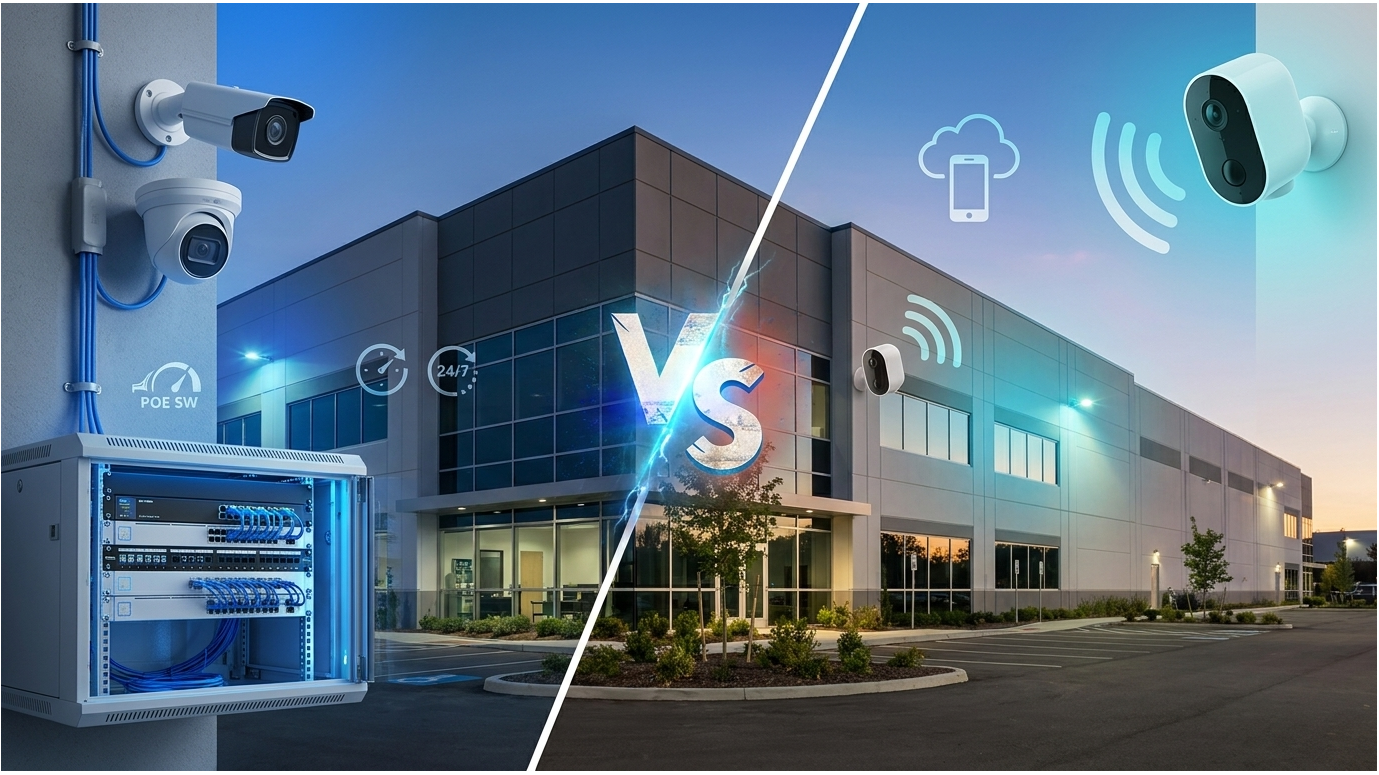
WiFi cameras communicate by transmitting video data over standard wireless radio bands — either 2.4 GHz or 5 GHz, the same frequencies used by home and business routers. A jammer works by broadcasting a wall of competing radio frequency noise across those same bands. The signal becomes so saturated with interference that the camera can no longer push data through to the router or cloud storage system.
Think of it like trying to have a phone conversation in the middle of a loud crowd. The camera is still transmitting, but nothing it sends can get through. The jammer does not need to hack the camera, bypass a password, or touch the device. It simply needs to be within range — often within 30 to 50 feet — to generate enough interference to break the connection. Higher-powered jammers can extend that range considerably, affecting multiple cameras across a larger area from a single device held in a jacket pocket or left in a parked car nearby.
Both frequency bands are vulnerable to this type of attack. Jammers designed to target both 2.4 GHz and 5 GHz simultaneously are widely available and require no technical expertise to operate.
No Feed, No Alerts, No Evidence
The real danger is not just losing the video feed — it is losing everything that comes with it. When a WiFi camera is jammed, it stops sending motion-triggered alerts to your phone. It stops uploading footage to cloud storage. It stops recording locally if it depends on a network-connected NVR. In many setups, the camera appears operational on the surface while producing zero usable evidence.
For a business owner who checks their app the next morning expecting a quiet overnight recording, the result is a blank timeline and an empty store. Jamming creates an invisible window of time where criminal activity can occur with no documentation. No footage means no evidence for insurance claims, no identifiable suspects for law enforcement, and no way to understand how the breach happened. That is not a minor inconvenience — it is the entire security system failing at the exact moment it matters most.
WiFi Jamming Has Already Hit Homes and Businesses
Nine Robberies in Minnesota Traced to WiFi Jammers
In 2024, a burglary in Edina, Minnesota was linked to thieves who used WiFi jammers to disrupt camera feeds before entering the property. That case became part of a broader pattern — investigators connected a string of nine burglaries across the Minneapolis-St. Paul metro area to criminals employing the same jamming tactic. The targets were not random. Burglars appeared to scout locations in advance, identify WiFi-dependent camera systems, and then use jammers to neutralize the surveillance before making their move.
What made these cases particularly alarming to security professionals was the deliberate, methodical use of consumer-grade jamming devices. This was not sophisticated nation-state-level hacking. It was a cheap gadget used by opportunistic criminals who had done their homework. The Minnesota cases drew national attention and highlighted a vulnerability that many business operators had never considered when setting up their wireless camera systems.
A Pattern That Extends Beyond the United States
The jamming threat is not limited to the United States. Security professionals in multiple countries have documented cases where wireless camera systems were disrupted during active criminal events, leaving property owners with gaps in their recorded footage and no usable evidence from the period when the crime occurred. In each instance, the disruption was only discovered after the fact — when reviewing footage and finding suspicious gaps in the recording timeline.
These cases confirm that jamming attacks are not rare edge cases. They are an established criminal tactic that has moved from theoretical vulnerability into documented, repeat use. For businesses that rely entirely on wireless cameras, these examples represent a clear preview of what a motivated bad actor could do to their own security setup.
Why Wireless Cameras Are Sitting Ducks
Jamming Is Just One of Several Weaknesses
Signal jamming is the most dramatic vulnerability in wireless camera systems, but it is far from the only one. WiFi cameras carry a broader set of weaknesses worth understanding before committing to a fully wireless setup — especially in a business environment where the stakes are higher than at home.
Beyond jamming, wireless cameras are commonly exposed through:
- Weak or default passwords — Many cameras ship with generic credentials that owners never change, making remote access trivially easy for anyone who knows the default login.
- Unencrypted video transmission — Some budget wireless cameras send footage over the network without encryption, allowing anyone intercepting the signal to view the feed.
- Outdated firmware — Manufacturers release security patches, but cameras that are not updated regularly remain vulnerable to known exploits.
- Insecure network configurations — Cameras placed on the same WiFi network as point-of-sale systems create pathways for lateral attacks.
- Power interruption — Battery-powered cameras can be taken offline simply by waiting for a charge cycle to expire, without triggering any alarm.
Each of these weaknesses exists independently of jamming. Together, they paint a picture of a camera type that offers genuine convenience but carries genuine risk — particularly in settings where continuous, tamper-resistant surveillance is a priority.
40% of IP Cameras Face Active Signal Risks
The scale of the problem is larger than most people assume. Approximately 40% of IP-based cameras face security risks from signal jamming and interference, which can create dangerous blind spots in surveillance coverage. That figure includes cameras installed in businesses that believe their security systems are fully operational — when in reality, they are exposed to disruption from a device small enough to fit in a coat pocket.
For small business owners, a security system that works most of the time is not an acceptable standard. A camera that functions perfectly 364 days a year but goes dark the one night a break-in occurs has failed at its core job. The 40% exposure figure is not a reason to panic — but it is a reason to take the camera selection decision seriously, and to understand what reliable actually means in the context of surveillance hardware.
Wired PoE Cameras: Immune by Design
Physical Cables Bypass Radio Frequency Attacks
Power over Ethernet (PoE) cameras solve the jamming problem entirely by removing radio frequency transmission from the equation. In a PoE system, a single Ethernet cable runs from each camera back to a PoE switch. That cable carries both power and video data — no WiFi router involved, no 2.4 GHz or 5 GHz band to flood, no wireless signal to intercept or disrupt. A jammer operating at full power within feet of a PoE camera will have zero effect on its recording or transmission.
The data travels through a physical, insulated Ethernet cable that reliably transmits up to 328 feet (100 meters) without signal degradation. Beyond that distance, a network switch extends the run further. This physical connection also provides continuous, stable power — eliminating the battery management overhead that comes with wireless systems. PoE cameras connected to a quality Network Video Recorder (NVR) can record continuously, 24/7, regardless of what is happening on any nearby wireless network. For businesses with critical assets — inventory storage, cash handling areas, server rooms — that level of reliability is the baseline standard, not a premium upgrade.
One Vulnerability Wired Systems Still Have
Wired PoE cameras are not completely invulnerable. Their primary remaining weakness is physical access to the cable itself. A determined intruder who locates and cuts an Ethernet cable can take that camera offline — though doing so requires being physically present, visible, and close to the cable run, which is itself a deterrent and a significant risk for the burglar.
Extremely powerful electromagnetic fields can theoretically interfere with wired systems, though this scenario is far more difficult to execute than carrying a simple WiFi jammer. The realistic takeaway: wired cameras are dramatically more resistant to the types of attacks that are actually being used in real burglaries today. Protecting cable runs with conduit, routing them through interior walls, and mounting cameras at heights that make cable access difficult addresses this remaining risk effectively — and these are all standard best practices in professional camera installations.
Which System Fits Your Business?
When Wired PoE Is the Right Call
Wired PoE systems are the clear choice for businesses where security cameras serve a critical function, not just a passive one. Specific situations where PoE is the right investment include:
- Permanent locations — Retail storefronts, warehouses, offices, and restaurants where cameras will stay in place long-term benefit most from a one-time wired installation.
- High-value asset areas — Anywhere cash is handled, inventory is stored, or sensitive equipment is kept warrants the added reliability of a wired connection.
- Locations with existing network infrastructure — If Ethernet cabling already runs through the building, extending it to cameras is straightforward and cost-effective.
- 4K and high-resolution requirements — Wired systems support 4K through 8K+ resolution without the bandwidth constraints that bottleneck wireless cameras.
- Businesses in higher-crime areas — Where motivated, prepared criminals are a real possibility, the jamming immunity of PoE cameras is a meaningful operational advantage.
The upfront installation cost of a wired PoE system is higher than wireless. Over several years, however, the total cost of ownership often favors wired — no battery replacements, fewer connectivity failures, and a substantially lower likelihood of a catastrophic gap in coverage.
When Wireless Still Makes Sense
There are legitimate scenarios where wireless cameras are a practical and reasonable choice. Wireless setups work well for:
- Temporary or rented spaces — If the business is in a short-term lease or pop-up location, running Ethernet cabling is not practical or cost-effective.
- Locations where cabling is impractical — Outdoor areas far from the building, detached structures, or locations with architectural barriers that make cable runs prohibitively expensive.
- Low-risk secondary monitoring zones — Areas like parking lot overviews or secondary entry points where coverage is supplementary rather than mission-critical.
- Rapid deployment needs — When a camera needs to go up quickly — a new location, a temporary event, a construction site — wireless gets the job done without a full installation crew.
In these contexts, wireless cameras add useful visibility. The key is understanding their limitations and not relying on them exclusively for coverage of the most sensitive areas of the business.
The Case for a Hybrid Setup
For many small businesses, the most practical answer is not wired or wireless — it is both. A hybrid surveillance setup deploys PoE cameras at the locations that matter most: entry points, cash registers, storage rooms, and any area where a gap in footage would be most damaging. Wireless cameras then fill in coverage at secondary locations where running cable is not feasible or cost-justified.
Many modern Network Video Recorders support mixed camera types, and cloud-based management platforms can also accommodate both wired and wireless feeds. The result is a setup that delivers the reliability of wired where it counts, and the flexibility of wireless where it makes the most sense — with the most critical coverage points protected from the jamming risk that wireless-only systems carry.
Wired PoE: The Most Reliable Choice for Critical Assets
When the goal is continuous, tamper-resistant, evidence-quality surveillance — the kind that holds up when it is actually needed — wired PoE systems are the clear answer. They do not rely on radio signals. They do not need battery charges. They are not affected by a $40 device someone picked up online. The video data moves through a physical cable, reaches the recorder, and stays there — regardless of what any jammer in the vicinity is doing.
That does not mean wireless cameras have no place in a business security plan. But placing wireless cameras on the most important coverage points and assuming they will perform when a prepared burglar shows up is a risk that the Minnesota cases and others have already shown to be misplaced confidence. The businesses that came out of those incidents with useful footage were the ones with wired systems — or hybrid setups where the critical angles were covered by PoE cameras that jamming simply could not reach.
The decision framework for small business owners is straightforward: identify the highest-risk locations, put wired PoE cameras there, and use wireless to fill in the gaps. Protect the cable runs. Keep firmware updated on any wireless devices. And do not assume that because the camera app shows a green light, the system is actually capturing what it needs to capture. Security hardware is only as strong as its weakest point of failure — and for wireless systems, that failure point is one cheap jammer away.
For expert guidance on building a surveillance and security strategy that does not leave blind spots, Nationwide Security Guards works with small businesses to assess vulnerabilities and implement layered security solutions that hold up when it matters most.
Nationwide Security Guards
142 Berkeley Street
Attn: Security Desk
Boston
MA
02116
United States


