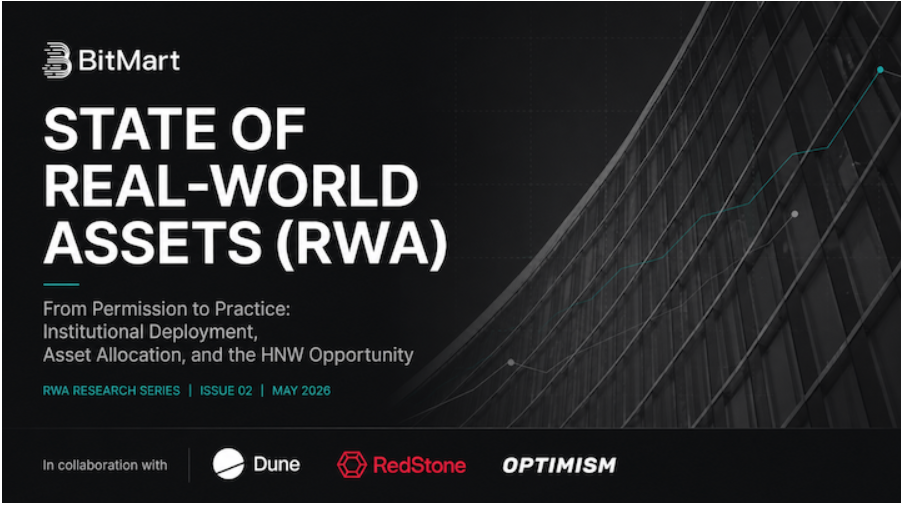
Mahe, Seychelles, May 20, 2026 (GLOBE NEWSWIRE) — BitMart, a leading global cryptocurrency exchange, today released the second issue of its State of Real-World Assets research series. Titled “From Permission to Practice: Institutional Deployment, Asset Allocation, and the HNW Opportunity,” the report examines the structural gap between the regulatory frameworks now in place and the institutional-scale capital deployment they are designed to enable.
Developed in collaboration with Dune, RedStone, and Optimism, the report brings together onchain data, oracle infrastructure, and Layer 2 deployment perspectives to deliver a cross-industry view of where the RWA market stands – and what it will take to close the gap between regulatory permission and real-world execution.
Building the Infrastructure Narrative, Not Just Covering It
BitMart launched the State of RWA series with a specific belief: that the most valuable contribution a globally compliant exchange can make to the RWA ecosystem is not product promotion, but honest analysis. The industry does not lack for optimism about tokenization. What it lacks is a rigorous, infrastructure-first assessment of why institutional capital is moving more slowly than the regulatory environment would suggest – and what it will actually take to close that gap.
Issue 02 is the continuation of that commitment. Where Issue 01 mapped the emerging landscape, Issue 02 goes deeper – into the operational barriers that custody gaps, liquidity fragmentation, and legal enforceability challenges create for institutional allocators, and into the disproportionate opportunity that tokenized RWA represents for the $90 trillion high-net-worth market. BitMart occupies a unique position to convene this analysis: serving clients across 180+ countries, operating at the intersection of institutional compliance and retail accessibility, and building infrastructure for the next generation of digital asset markets.
The co-authorship model – bringing in Dune for onchain data, RedStone for oracle and settlement infrastructure, and Optimism for L2 deployment realities – reflects a deliberate choice to ground every claim in operational evidence rather than market narrative.
What the Data Shows
Onchain RWA TVL surged from approximately $6 billion in early 2025 to $24.6 billion by April 2026 – a nearly fivefold increase. The GENIUS Act, MiCA, and Hong Kong’s Stablecoin Ordinance collectively established the first coherent cross-jurisdictional compliance architecture for tokenized asset issuance. The regulatory window is open.
Yet of approximately $27 billion in tokenized RWAs onchain, only around 10 percent is actively used as DeFi collateral. The remaining 90 percent sits in wallets as yield-bearing balances – productive, but not composable. The report’s central finding is that this is not a regulatory problem or a demand problem. It is an infrastructure problem: custody standards, cross-chain liquidity, legal enforceability, and institutional-grade reporting all remain under construction. The institutions that solve these layers first will define the competitive landscape for the next decade of digital asset markets.
Key data points from the report: BlackRock’s BUIDL fund crossed $2.4 billion in AUM – a 12-fold increase in under two years – illustrating what is achievable when brand trust, compliant custody architecture, and DeFi integration converge. Tokenized private credit, offering 8 to 12 percent annualized yields, dominates DeFi lending deposits despite representing a fraction of total tokenized AUM. And for high-net-worth investors, a 5 percent allocation to tokenized RWA from the global HNW and UHNW population would represent more than 160 times the current total market size – the single largest untapped opportunity in the space.
Co-Author Perspectives
Dune’s contribution maps the composability gap at the onchain level – showing that the most widely held tokenized assets are the least actively deployed as collateral, and why integration design matters more than chain count. RedStone identifies the maturity mismatch at the heart of RWA-DeFi integration: infrastructure built for assets that settle in seconds cannot natively handle a 90-day Treasury or a trade finance receivable. Optimism provides ground-level signal from the mid-2026 institutional deployment wave, including proprietary TVL data from OP Mainnet following the April launches of BlackRock BUIDL, Mitsui’s ZipangCoin, and EtherFi’s 300,000-account migration.
“The RWA market has cleared the regulatory hurdle. What comes next is harder and more important: building the operational infrastructure that makes institutional deployment possible at scale. BitMart Research exists to track that work honestly – where progress is real, where gaps remain, and what it will take to close them. Issue 02 is our answer to that question for 2026.” – BitMart Research
Report Availability
The full report is available for download at: https://bit.ly/BitMart-RWA02
This report is provided for informational and educational purposes only and does not constitute financial, legal, or investment advice.
About BitMart
BitMart is a premier global digital asset trading platform with more than 13 million users worldwide. Consistently ranked among the top crypto exchanges on CoinGecko, BitMart offers over 1,700 trading pairs with competitive fees. Committed to continuous innovation and financial inclusivity, BitMart empowers users globally to trade seamlessly. Get started with BitMart here.
About Dune
Dune is the data platform that makes blockchain data available. Extensive coverage, curated verticals, and multiple distribution methods – Dune app, API, data share – designed to fit institutional workflows and use cases.
About RedStone
RedStone is the data layer for institutional DeFi, delivering secure, low-latency price feeds for digital assets, RWAs, stablecoins, LSTs, LRTs, and Bitcoin LSTs across 110+ chains. Trusted by 200+ clients including Securitize, Morpho, Pendle, Spark, Ether.fi, Ethena, Lombard, Venus, and Compound, RedStone powers lending, stablecoins, perpetuals, and tokenized asset markets with a custom pricing infrastructure built for complex onchain systems. RedStone is the primary oracle for tokenized products including BlackRock’s BUIDL, Apollo ACRED, and Hamilton Lane SCOPE.
About Optimism
Optimism is a blockchain infrastructure provider that enables developers and enterprises to launch scalable, secure, and customizable networks and applications. Its open source OP Stack delivers Ethereum-grade security, near-zero transaction costs, and the flexibility to meet business and regulatory needs at scale. Optimism serves fintechs, payment providers, institutions, and crypto companies building the next generation of onchain products.
Disclaimer:
The information provided is for informational purposes only and should not be considered a recommendation to buy, sell, or hold any financial assets. All information is provided in good faith. However, we make no representation or warranty of any kind, express or implied, regarding the accuracy, adequacy, validity, reliability, availability or completeness of such information.
All crypto investments, including earnings, are highly speculative in nature and involve substantial risk of loss. Past, hypothetical, or simulated performance is not necessarily indicative of future results. The value of digital currencies can go up or down and there can be a substantial risk in buying, selling, holding, or trading digital currencies. You should carefully consider whether trading or holding digital currencies is suitable for you based on your personal investment objectives, financial circumstances, and risk tolerance. BitMart does not provide any investment, legal or tax advice.

press(at)bitmart.com