American Institute of Artificial Intelligence Unveils Internally Developed Foundation-Model Architectures, Transformer Systems, and World Models
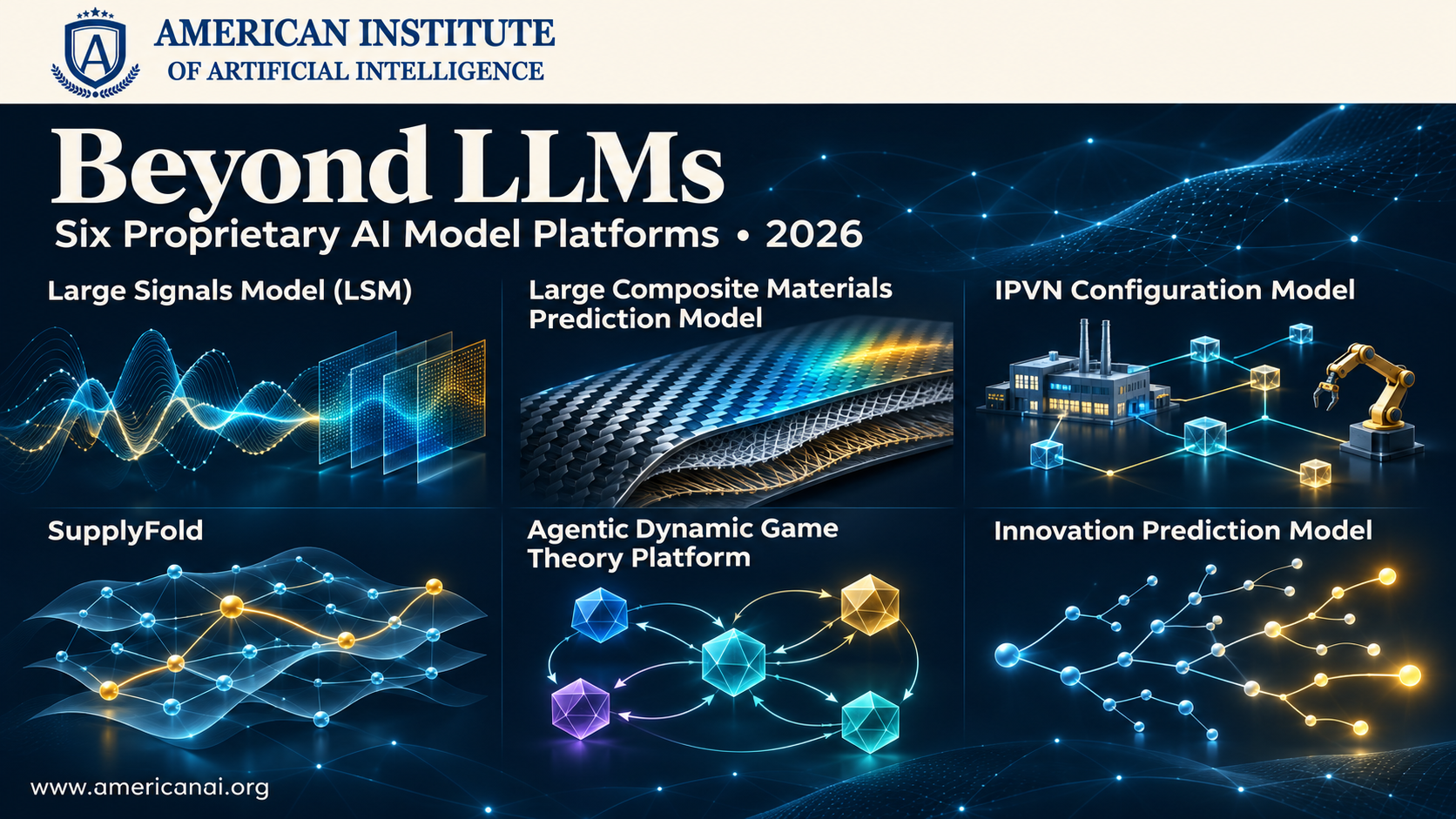
WASHINGTON, DC, UNITED STATES, November 18, 2026 /EINPresswire.com/ — The American Institute of Artificial Intelligence (AmericanAI) today announced significant advances in six internally developed artificial intelligence model platforms during 2026, marking a major expansion of its research in foundation models, transformer architectures, predictive world models, graph-based intelligence, and autonomous multi-agent systems.
Unlike conventional AI applications built primarily upon commercially available large language models (LLMs), AmericanAI’s research focuses on developing proprietary model architectures capable of learning from physical signals, predicting complex system behavior, understanding interconnected networks, and supporting intelligent autonomous decisions.
“Much of the AI industry is focused on building applications around existing language models,” said Dr. Al Naqvi, Founder and CEO of AmericanAI. “Our research is focused on something fundamentally different: developing AI models that can understand signals, learn how physical and economic systems behave, anticipate changes, and engineer intelligent responses. We are moving beyond AI that generates answers toward AI that understands, predicts, and acts in the real world.”
Six Major AI Research Initiatives
1. Large Signals Model (LSM) — A Foundation Model for Physical Signals
Developed through AmericanAI’s research for the U.S. Air Force Research Laboratory (AFRL), the Large Signals Model represents a new approach to learning from radar, radio frequency, communications, and other physical signals. Using transformer-based architectures and learned signal representations, LSM is designed to support multiple tasks—including signal characterization, classification, parameter estimation, anomaly detection, and prediction—within a reusable model framework rather than requiring separate AI systems for every signal application. AmericanAI’s signals research also includes seven patents in this technology domain and a proprietary Signals Language and compiler, extending the architecture beyond individual AI models toward a programmable signals intelligence environment.
2. Large Composite Materials Prediction Model — AI for Advanced Materials
AmericanAI has developed a specialized predictive model architecture focused on understanding complex composite materials and their behavior.
The research applies advanced machine learning to relationships among material characteristics, manufacturing variables, and performance outcomes, with potential applications in aerospace, defense, advanced manufacturing, and materials engineering. The objective is to move beyond traditional analysis toward learned representations capable of supporting predictions in complex engineering environments.
3. IPVN Configuration Model — Engineering Intelligent Supply Chains
The Intelligent Physical Value Network (IPVN) Configuration Model represents AmericanAI’s research into dynamically engineering entire supply chains.
The architecture uses dynamic capability graphs, transformer-based representations, and world-model concepts to represent enterprise work, software, AI agents, technologies, physical assets, and operating constraints. Rather than merely optimizing existing supply chain processes, the model is designed to identify how intelligence and physical autonomy can be configured, integrated, and continuously adapted across enterprise networks. It provides an AI research foundation for IPVN Engineering and the emerging standards-development work of the IPVN Institute.
4. SupplyFold — Predictive Intelligence for Complex Supply Networks
Inspired conceptually by the structural-learning advances demonstrated by AlphaFold in molecular biology, AmericanAI developed SupplyFold to address the complexity of supply networks. SupplyFold uses graph-based learning and predictive architectures to model interconnected suppliers, dependencies, vulnerabilities, and potential disruption pathways. The research also incorporates Contested Configuration Theory (CCT), developed by Dr. Naqvi, which examines how military logistics and supply chain configurations must adapt under adversarial conditions. Its applications span defense logistics, supply chain risk management, critical infrastructure, and enterprise resilience.
5. Agentic Dynamic Game Theory Platform — Modeling Competitive Intelligence and Strategic Behavior
AmericanAI has also developed an agentic modeling platform combining multi-agent AI architectures with dynamic game theory. The platform is designed to represent competing actors, changing objectives, strategic interactions, and adaptive behavior in environments where decisions made by one participant influence the actions of others. Potential applications include military strategy, contested operations, corporate competitive intelligence, market dynamics, negotiations, and strategic planning. Unlike conventional static scenario analysis, the research explores how AI agents can model and adapt to evolving competitive environments.
6. Innovation Prediction Model — Anticipating Technological Change
AmericanAI’s Innovation Prediction Model focuses on the challenging problem of understanding and anticipating technological evolution.
The research explores how learned representations, knowledge relationships, and predictive architectures can identify emerging technologies, evolving capabilities, and potential innovation pathways. Its intended applications include corporate R&D strategy, technology investment, competitive intelligence, industrial planning, and national security technology assessment.
A Research Strategy Built on Proprietary AI Architectures
Together, these initiatives demonstrate AmericanAI’s commitment to developing internally engineered AI models and foundational architectures, rather than depending exclusively on third-party language models.
A common research direction connects the six initiatives: learning meaningful representations of complex systems, modeling how their states change, anticipating future conditions, and supporting intelligent decisions.
“Our focus is not simply on making AI models larger,” said Nur Naqvi, Chief Technology Officer of AmericanAI. “It is on creating architectures that can learn the structure and behavior of complex systems. Transformer models help us discover relationships within data. World models allow us to investigate how those systems evolve. Graph intelligence and multi-agent architectures extend these capabilities toward coordinated decisions and autonomous operations.”
“These are difficult scientific and engineering problems,” Nur Naqvi continued. “Building foundational AI capabilities internally gives us the freedom to design architectures around the problem rather than forcing the problem into the limitations of an existing model.”
From Scientific Research to Enterprise and National Security Applications
AmericanAI’s research spans multiple sectors, including defense, aerospace, advanced materials, global supply chains, competitive intelligence, and autonomous physical systems. The Institute’s broader objective is to translate advances in AI architectures into reusable technologies capable of addressing complex real-world challenges.
“We believe the next major advances in artificial intelligence will come from combining multiple model architectures,” said Dr. Naqvi. “Language models are important, but intelligence also requires perception, structured representations, prediction, reasoning, and the ability to adapt to changing environments. Our six research initiatives reflect our conviction that the future of AI will be defined not simply by language, but by models capable of understanding and engineering the physical and strategic world.”
About the American Institute of Artificial Intelligence
Founded in 2016, the American Institute of Artificial Intelligence (AmericanAI) is an AI research, technology development, education, and professional standards organization serving commercial, government, and national security sectors. Its research includes foundation-model architectures, transformers, world models, large signals models, graph learning, multi-agent systems, and autonomous intelligence. AmericanAI is led by Dr. Al Naqvi, an AI scientist, former Fortune 500 Chief Procurement Officer and Global Sourcing Vice President, and author of 17 books, including three published with Wiley.
American Institute of Artificial Intelligence
Website: www.americanai.org
Marya Naqvi
AmericanAI
+1 202-823-7444
Visit us on social media:
LinkedIn
Legal Disclaimer:
EIN Presswire provides this news content “as is” without warranty of any kind. We do not accept any responsibility or liability
for the accuracy, content, images, videos, licenses, completeness, legality, or reliability of the information contained in this
article. If you have any complaints or copyright issues related to this article, kindly contact the author above.

Media gallery