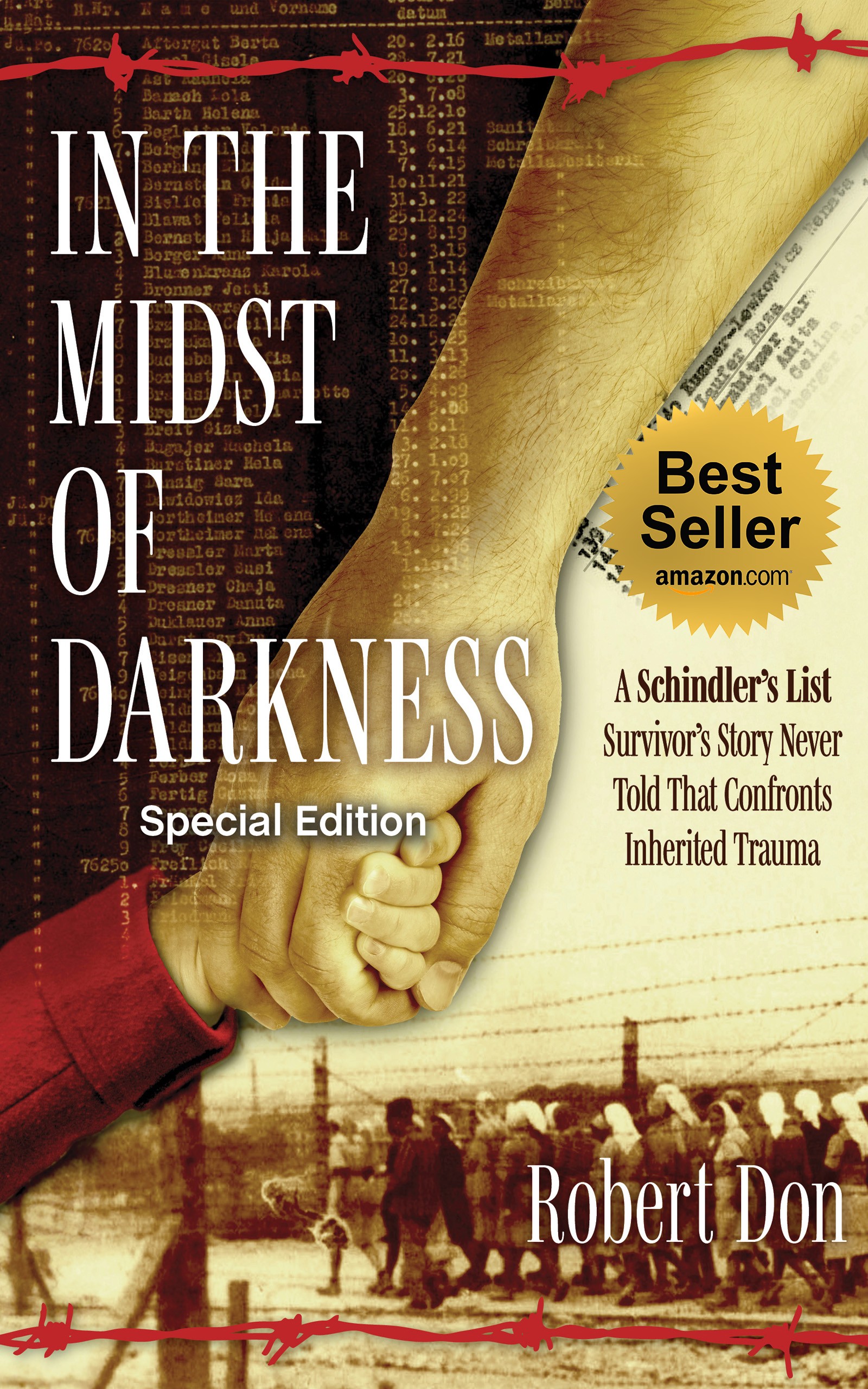

In the Midst of Darkness has become an Amazon bestseller in three Holocaust and sociology categories, spotlighting trauma, racism, and reconciliation.
CHICAGO, IL, UNITED STATES, November 25, 2026 /EINPresswire.com/ — Robert Don’s In the Midst of Darkness has reached Amazon bestseller status across three categories: Sociology of Race Relations, General Sociology of Race Relations, and Holocaust Biographies. The deeply personal memoir explores a rarely told aspect of Holocaust history: the lasting impact of survivor trauma on the children who inherit its emotional weight.
The book’s growing recognition has also been highlighted in a USA Today press release, spotlighting its Amazon bestseller achievement and powerful Holocaust family story, while bringing greater attention to the lasting effects of inherited trauma, prejudice, and the possibility of reconciliation.
On a Jewish Holy Day
On Yom Kippur day, October 1993, my rabbi’s sermon in synagogue was the story of Oskar Schindler due to the upcoming release of “Schindler’s List” that would debut in the next six weeks. It had been five years since my mother passed away. At the end of the Rabbi’s sermon, my father leaned over to me in the temple and told me something that she never did. They were six words I would never forget.
“Your mother was on that list.”
Robert’s story begins with a question that shaped his entire life: What happens when a child grows up carrying the fears, pain, and beliefs created by a parent’s unimaginable trauma?
The son of Holocaust survivor Rosa Laufer Don, Robert grew up surrounded by memories of loss and survival. His mother endured Nazi persecution, lost her entire family – both parents, her four sisters, and a brother in the Auschwitz and Belzec extermination camps, but survived because she was among the Jewish people protected by German industrialist Oskar Schindler. Yet the full significance of her survival, and the story behind it, was something Robert would only discover years later, never knowing while she was alive that she was a “Schindler’s List” survivor.
As a child, Robert struggled to understand the impact of his mother’s Holocaust experiences on his family. Her memories shaped how he viewed the world, relationships, and the people around him. He absorbed the fears and anger that came from her suffering, particularly in how he viewed his German stepmother, Kathy, and every other German. But what that did to his brother was immeasurable: he suffered a nervous breakdown when he was 23, and his brother was only 13. He never recovered from what happened to him, and throughout his adult life he was deeply impacted by mental illness, a fate Robert often felt could have been his own. The unrelenting irony is that his brother never knew, or he, for over two decades, that his mother and over 1200 other Jewish lives were saved by a German, let alone a member of the Nazi Party.
In the Midst of Darkness examines the complex reality of second-generation Holocaust survivors: children who did not experience the Holocaust firsthand but grew up deeply affected by its consequences. Robert explores how unresolved trauma can influence identity, family relationships, emotional health, and perceptions of others across generations.
The memoir asks difficult questions that extend far beyond one family’s experience:
• How does trauma pass from one generation to another?
• How do children separate inherited beliefs from their own understanding?
• Can people confront painful histories and find a path toward greater compassion?
“We cannot choose what we inherit as children, but with awareness, compassion, and courage, we can learn to see people through our own lens,” said Robert Don.
Inherited trauma related to the experiences of Holocaust survivors that has been passed on to their children continues to affect people today. The numbers are staggering: there may be over 10 million people living with the legacy of this trauma, yet it’s often unspoken. Of these, there may also be 7-8 million direct descendants of survivors who are Jewish and may be impacted by generational trauma. That is approximately 50% of the world’s Jewish population and doesn’t even account for what subsequent and future generations may confront or will need to bear.
The recognition of In the Midst of Darkness across sociology, race relations, and Holocaust biography categories reflects the book’s relevance to readers interested not only in Holocaust history, but also in psychology, family dynamics, prejudice, resilience, and reconciliation.
===================
About the Author
Robert Don has been changing careers from his professional background in senior risk management in corporate banking to becoming a writer. He recently conducted research in both the Auschwitz and Plaszów concentration camps, where his mother was deported, and is deeply familiar with the Holocaust stories being told. Having lived through this story, he finally wanted to tell the story and is well-versed in the details of this time period of the Holocaust.
Aleyna Wren
The Chicago Publishers
Visit us on social media:
Instagram
Facebook
Legal Disclaimer:
EIN Presswire provides this news content “as is” without warranty of any kind. We do not accept any responsibility or liability
for the accuracy, content, images, videos, licenses, completeness, legality, or reliability of the information contained in this
article. If you have any complaints or copyright issues related to this article, kindly contact the author above.

Media gallery