Built for surgical visualization, endoscopy, and diagnostic devices that cannot tolerate motion blur or excessive sensor noise, this camera pairs the Onsemi AR0235 HyperLux SG sensor with global shutter capture, Dynamic ROI, and low-noise monochrome imaging over USB 3.2 Gen 1, giving medical device manufacturers precise, motion-free video without a proprietary interface to manage.
FORT WORTH, TX / ACCESS Newswire / August 24, 2026 / Vadzo Imaging, a provider of embedded vision solutions, today launched the Falcon-235MGS, a 2MP USB Camera built around the Onsemi AR0235 HyperLux SG sensor for surgical visualization, diagnostic imaging, and portable medical device applications that need motion-free capture and low noise sensitivity over a standard USB connection.
Why Medical Devices Need a 2MP USB Camera Built for Motion and Precision
Medical imaging applications routinely capture scenes with motion that a standard rolling shutter camera was never designed to handle cleanly. A rolling shutter sensor exposes each row of the frame at a slightly different moment, which introduces a skewing or smearing effect on anything moving during that exposure window, whether that is a surgical instrument in motion, a patient’s own natural movement, or the camera itself being repositioned by hand. In a surgical or diagnostic context, that skewing is not just an aesthetic flaw; it can obscure exactly the detail a clinician needs to see clearly.
An AR0235 Global Shutter USB Camera solves that problem by exposing the entire sensor at the same instant, capturing a geometrically accurate frame regardless of what is moving within it. This matters directly for any medical application where the subject, the instrument, or the camera itself is not guaranteed to stay still during capture, which describes the vast majority of real surgical and diagnostic use cases far more accurately than a controlled, static bench test would suggest.
A second, related challenge is sensor noise, which becomes more pronounced in global shutter designs than in comparable rolling shutter sensors due to the additional in-pixel circuitry global shutter capture requires. A Low-Noise Global Shutter Camera addresses that balance directly at the sensor level, rather than asking downstream image processing to clean up a noisier signal after the fact, which matters for diagnostic applications where subtle detail can be lost in noise that a global shutter design would otherwise introduce.
Motion accuracy and low noise sensitivity are not independent requirements in a real medical device; they compound each other in practice. A sensor that solves motion artifacts but introduces excessive noise still leaves a clinician looking at a geometrically accurate but visually degraded image, while a low-noise sensor that cannot handle motion produces a clean but blurred frame. Solving both from the same sensor platform is what actually makes a camera usable for medical imaging rather than merely adequate on one specification at the expense of the other.
Engineering Explanation: Motion, Noise, and Selective Readout Together
Onsemi designed the AR0235 as part of its HyperLux SG family, specifically engineering the sensor to minimize the read noise penalty that global shutter designs typically carry compared to rolling shutter alternatives. As an AR0235 Mono Camera, the sensor pairs that low-noise global shutter architecture with a monochrome pixel design, which matters directly for medical imaging tasks where color information is unnecessary and a monochrome sensor’s higher effective sensitivity and resolution per pixel provide a genuine advantage over a color equivalent.
That monochrome sensitivity advantage is not a minor detail for medical applications. As an Onsemi AR0235 Camera, the Falcon-235MGS resolves fine structural detail in diagnostic and surgical imaging without a color filter array reducing the light reaching each pixel, which directly improves image clarity in exactly the kind of dim, hard-to-light internal cavity or diagnostic scenario common in medical devices. A Low Noise Monochrome Camera configuration like this one gives medical device manufacturers a sensor built specifically around this balance rather than a color sensor with reduced sensitivity accepted as an unavoidable cost.
Dynamic ROI extends the sensor’s usefulness beyond full frame capture alone. As a 2MP Dynamic ROI USB Camera, the AR0235 can be configured to read out a smaller, defined region of the sensor at a substantially higher frame rate than a full frame capture would allow, which matters for medical applications tracking a specific instrument tip or a localized area of interest rather than an entire field of view. A Dynamic ROI Global Shutter Sensor configuration like this one gives medical device integrators the flexibility to choose between wide field visualization and fast, localized tracking from the same hardware rather than requiring two separate camera products.
An ROI Windowed Global Shutter Camera approach also reduces the data bandwidth and processing load a downstream system needs to handle, since a windowed region of interest produces less data than a full frame capture at the same frame rate. As a Low Noise CMOS Sensor Camera, the Falcon-235MGS gives medical device manufacturers that flexibility without asking their processing hardware to handle full frame data volume when only a smaller region actually matters for a given task.
Product Overview
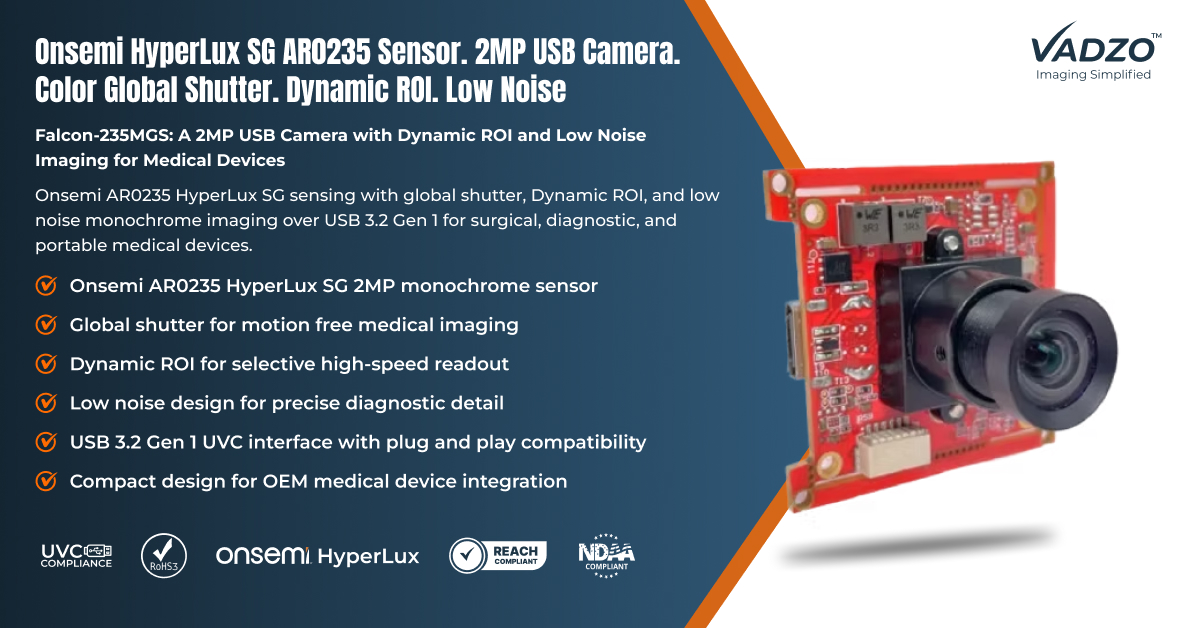
The Falcon-235MGS pairs the AR0235 Sensor with global shutter capture, Dynamic ROI, and USB 3.2 Gen 1 connectivity in a compact design suited to surgical, diagnostic, and portable medical device integration. As a 2MP USB Camera, it outputs full-resolution monochrome capture with global shutter and low-noise processing active by default, giving medical device manufacturers a single camera platform that covers visualization, documentation, and general-purpose medical imaging from one module.
At the core of the module sits the HyperLux SG Camera sensor, chosen specifically for the combination of low noise, global shutter capture, and Dynamic ROI flexibility that medical device programs require. Because the camera pairs 2MP low-noise camera sensitivity with 2MP Global Shutter Mono Camera capture, the Falcon-235MGS reaches usable image quality in motion-sensitive, low-light medical scenarios where a standard rolling shutter or color sensor would introduce compromises a clinician cannot afford.
Product Specifications
Key specs: 2MP (1920 × 1200) | Onsemi AR0235 HyperLux SG, 1/2.8 -inch | 2.8 µm Pixel | Monochrome, Global Shutter | USB 3.2 Gen 1 Interface | S-Mount (M12) Optics
Key Capabilities
Onsemi AR0235 HyperLux SG Sensor for Low Noise Global Shutter Capture: The Falcon-235MGS is built around the Onsemi AR0235 HyperLux SG sensor, a device engineered specifically to minimize the read noise penalty that global shutter designs typically introduce compared to rolling shutter alternatives. This gives the module genuine 2MP ROI Sensor Module performance suited to medical applications that need both motion-free capture and diagnostic-level image clarity from the same hardware. That combination matters because a sensor optimized for only one of these properties would force a medical device manufacturer to accept a compromise somewhere in the imaging chain, whether that compromise shows up as visible noise, motion blur, or reduced sensitivity in low light conditions.
Dynamic ROI for Selective High-Speed Readout: Not every medical imaging task requires a full frame capture at the sensor’s maximum resolution, and reading out the entire array when only a small region matters wastes both bandwidth and processing time. As a 2MP HyperLux Camera, the Falcon-235MGS lets integrators define a smaller readout region that streams at a meaningfully higher frame rate, which matters for applications tracking a specific instrument or localized area of interest rather than an entire field of view.
Global Shutter for Motion-Free Medical Imaging: Surgical instruments, patient movement, and handheld camera repositioning all introduce motion that a rolling shutter sensor exposes unevenly across a frame, producing skew or smearing that a global shutter design avoids entirely. By exposing the full sensor array at the same instant, the Falcon-235MGS captures a geometrically accurate frame regardless of what is moving within it, which matters directly for surgical visualization and diagnostic tasks where that accuracy cannot be compromised.
Low Noise Monochrome Sensitivity for Precise Diagnostic Detail: A monochrome sensor captures more usable light per pixel than a color equivalent, since there is no color filter array absorbing a portion of incoming light before it reaches the photodiode. As an AR0235 Low Noise Camera, the Falcon-235MGS combines that inherent monochrome sensitivity advantage with sensor-level noise reduction, giving medical device manufacturers diagnostic-level image clarity in the dim, hard-to-light conditions common inside an internal cavity or a compact diagnostic device housing.
USB 3.2 Gen 1 UVC Plug and Play Compatibility: As a USB 3.2 Gen 1 UVC Camera Module, the Falcon-235MGS enumerates automatically on Windows, Linux, and Android without a proprietary driver install, which matters directly for medical device manufacturers integrating a camera into existing diagnostic or documentation software that already expects a standard UVC device. This makes it a genuine Plug and Play Medical Camera option for integrators who need global shutter image quality without a specialized interface or a custom capture card. As a USB 3.2 Medical Camera, it delivers that plug-and-play simplicity specifically at the bandwidth USB 3.2 Gen 1 provides.
Compact OEM Ready Design for Medical Device Integration: The module’s compact footprint gives OEM customers flexibility to integrate the Falcon-235MGS into a surgical instrument handle, an endoscope, or a portable diagnostic device housing without a major mechanical redesign. Vadzo Imaging supports full customization on this platform as an OEM Medical Device Module, including connector changes, optics selection, and firmware adjustments for medical device manufacturers headed into regulated volume production.
“Medical device teams keep telling us the same thing: a camera that blurs a moving instrument or introduces visible noise into a dim internal view is not just an image quality problem; it directly affects what a clinician can trust in the image. The AR0235’s global shutter and low-noise monochrome sensitivity give the Falcon-235MGS genuine motion-free clarity in exactly the conditions medical imaging presents, delivered over a standard USB connection medical device teams already know how to integrate. We built this camera for devices where the image must be trustworthy, not just technically in focus.” – Alwin Vincent, Product Manager at Vadzo Imaging.
Application-Specific Sections
Surgical Visualization and Endoscopy: Surgical visualization and endoscopic imaging depend on a stable, motion-free view even as an instrument or scope moves through a natural or surgical opening with constant small motion. As a Surgical Device Camera Module, the Falcon-235MGS’s global shutter holds that view steady, and functioning as a Medical Scope Camera Module, it integrates directly into an endoscope or surgical visualization tower without the motion artifacts a rolling shutter sensor would introduce.
Diagnostic and Point of Care Devices: Diagnostic devices used at the point of care need reliable image quality across a range of lighting and handling conditions outside a controlled lab environment. As a Diagnostic Device Camera, the Falcon-235MGS delivers that reliability, and a Point of Care Vision Camera configuration of the same module extends the same image quality to bedside and clinic-based diagnostic tools. As a Medical Equipment Vision Camera, it also supports broader diagnostic equipment integration beyond dedicated point-of-care devices.
Handheld and Portable Medical Devices: Handheld and portable medical devices introduce natural hand motion that a rolling shutter sensor would render as visible frame distortion, which makes global shutter capture a genuine clinical requirement rather than a convenience feature. As a Handheld Medical Device Camera, the Falcon-235MGS corrects for that motion inherently, and a Compact Medical Imaging Camera configuration gives portable device manufacturers dependable image quality regardless of how steadily a given user holds the device.
Medical Device OEM Integration: Medical device manufacturers building their own surgical, diagnostic, or monitoring equipment need a camera vendor who understands the motion, noise, and connectivity requirements a regulated device demands. The Falcon-235MGS ships from a Medical Camera Manufacturer with those requirements built in, and Vadzo Imaging supports OEM customization for optics, connector configuration, and firmware for device programs standardizing on one camera platform. That standardization becomes increasingly valuable as a manufacturer’s product portfolio grows, since qualifying a single camera platform across several device models is considerably less engineering and regulatory work than qualifying a different vendor’s camera for each product line.
Medical Imaging Carts and Fixed Equipment: Not every medical imaging application is handheld, and fixed equipment such as imaging carts and mounted visualization towers still benefit from the same global shutter accuracy and low noise sensitivity. A Medical Device Camera platform like this one gives equipment manufacturers a consistent camera choice across both fixed and mobile product lines, and as a Medical Device USB Module, it meets the durability and image quality expectations a clinical environment requires across both fixed and portable equipment.
Frequently Asked Questions
Q: Why does a medical device camera need a global shutter instead of a rolling shutter sensor?
A: A rolling shutter sensor exposes each row of a frame at a slightly different moment, which introduces a skewing or smearing effect on anything moving during that brief exposure window, whether that is a surgical instrument, natural patient movement, or the camera itself being repositioned by hand. A global shutter sensor exposes the entire frame at the same instant instead, producing a geometrically accurate image regardless of what is moving within it. Vadzo Imaging selects global shutter sensors for its medical device camera products specifically because very few real surgical or diagnostic scenarios stay perfectly still, and a camera that only performs well in a static bench test is not actually representative of how the device will be used in practice. A device manufacturer evaluating camera options should weight real-world motion conditions at least as heavily as resolution or frame rate specifications, since a high-resolution image that is smeared by motion provides less diagnostic value than a lower resolution frame that is geometrically accurate.
Q: Why would a medical imaging camera use a monochrome sensor instead of a color sensor?
A: A color sensor uses a filter array over each pixel to separate incoming light into red, green, and blue channels, which necessarily reduces the amount of light reaching any individual pixel compared to a monochrome sensor with no filter in place. For medical applications where color information is not clinically necessary, that monochrome sensitivity advantage translates directly into better image clarity in dim, hard-to-light conditions such as an internal cavity or a compact diagnostic device housing. Vadzo Imaging offers its medical device camera products in monochrome configurations specifically for these applications, since accepting a color sensor’s reduced sensitivity would be a real image quality cost without a corresponding clinical benefit.
Q: What is a dynamic region of interest readout, and why would a handheld medical device need it?
A: Dynamic region of interest readout lets a camera capture a smaller, defined portion of its full sensor array at a significantly higher frame rate than reading out the entire frame would allow, while retaining the ability to capture full resolution when a wider view is needed. For a handheld medical device tracking a specific instrument tip or a localized area of interest, that flexibility means faster, more responsive tracking without the bandwidth and processing burden of full frame capture at every moment. Vadzo Imaging builds this capability into its medical device camera products so device manufacturers get both wide field visualization and fast, localized tracking from the same hardware rather than needing a separate camera for each task.
Q: Can Vadzo Imaging customize a medical device camera module for a specific surgical or diagnostic platform?
A: Yes. Vadzo Imaging supports full OEM customization across its medical device camera portfolio, including optics selection suited to a specific working distance or field of view, connector and cable configuration matched to a particular device housing, and firmware adjustments tuned for a specific Dynamic ROI or noise reduction profile. Evaluation units ship with no minimum order requirement, and the same engineering team that built the standard product works directly with medical device manufacturers to adapt the module for a specific surgical, diagnostic, or monitoring platform headed into regulated production.
Q: How does Vadzo Imaging support medical device manufacturers through regulatory and long-term production requirements?
A: Regulated medical device programs depend on component consistency and traceability over a production life that can span many years, which makes a supplier’s ability to maintain the same core sensor and firmware platform, along with clear documentation of any component changes, just as important as the camera’s initial specifications. Vadzo Imaging supports that consistency by keeping stable hardware and firmware revisions available across a long product lifecycle, backed by direct engineering support so a manufacturer is not left managing undocumented component changes mid-production. That approach lets a medical device program move from initial evaluation through regulatory submission and into volume manufacturing without the underlying camera platform changing unexpectedly along the way. Manufacturers should ask a prospective camera supplier directly about component change notification practices and long-term part availability commitments, since these details rarely appear on a standard specification sheet but matter enormously once a device enters regulated production.
Availability
The Falcon-235MGS 2MP USB Camera is available now for evaluation and OEM integration. Evaluation kits include the camera module, a factory-calibrated S-Mount lens, a USB 3.2 Gen 1 cable, and integration documentation covering Dynamic ROI configuration and global shutter setup, with no minimum order requirement. Contact Vadzo Imaging at support@vadzoimaging.com to request an evaluation unit or discuss volume production and OEM customization. Evaluation feedback is also welcome directly through the same contact channel, since real deployment conditions across a pilot integration often surface details a bench test alone would not reveal.
About Vadzo Imaging
Vadzo Imaging develops embedded and machine vision camera products for OEMs, system integrators, and medical device manufacturers building production-ready vision systems across surgical visualization, diagnostics, industrial automation, and edge AI. The company’s portfolio spans MIPI CSI-2, USB, GigE, Wi-Fi, FPD-Link III, and SerDes interface camera products, supporting deployment architectures from compact onboard modules to distributed networked installations. Vadzo provides end-to-end imaging support, including sensor integration, ISP tuning, firmware development, and SDK frameworks to accelerate system deployment, and the company’s engineering team works directly with customers throughout evaluation, pilot deployment, and volume production rather than handing off support after the initial sale. Visit Vadzo Imaging to explore the full embedded vision camera portfolio.
Media Contact
Alwin Vincent
Vadzo Imaging
Email: alwin@vadzoimaging.com
LinkedIn: Vadzo Imaging
YouTube: Vadzo Imaging
X: Vadzo Imaging
SOURCE: Vadzo Imaging
View the original press release on ACCESS Newswire
Media gallery